
My Sister Showed Up at Our Anniversary Claiming My Husband Got Her Pregnant—Then I Found Her Hospital Bracelet
My Sister Showed Up at Our Anniversary Claiming My Husband Got Her Pregnant—Then I Found Her Hospital Bracelet
Five Years
Five years sounds like a long time until you're actually living inside it, and then it feels like something you built together so slowly you barely noticed it taking shape. We'd decided against a restaurant this year — no waiting for a table, no ambient noise, no performance of romance. Just the two of us at our own dining table with the good dishes we never used and a bottle of Barolo we'd been saving since the wedding. Mark had wrapped my gift in the same crooked, tape-heavy way he always did, which made me laugh before I even opened it — a small framed print of the menu from the terrible Thai place where we'd had our first date, the one that closed two years ago. He'd tracked it down somehow. I didn't ask how. We opened the wine and it was better than we remembered, or maybe we were just in the right mood for it. He told the story of how he'd nearly dropped the rings at the altar, which I'd heard a dozen times, and I still laughed. The candles burned low. The food went cold because we kept talking instead of eating. Outside, the neighborhood had gone quiet. The warmth of that evening settled around us like something we'd earned.
 Image by RM AI
Uninvited
We were halfway through dessert — a chocolate torte I'd made from scratch, which was ambitious and slightly lopsided — when the doorbell rang. Mark and I looked at each other across the table the way you do when you're not expecting anyone and it's already past nine on a weeknight. I figured it was a neighbor, maybe a package delivery gone wrong. I set my fork down and went to the door. Sarah was standing on the front step with a bag over her shoulder and her coat still buttoned, like she'd come from somewhere else and just stopped here on the way. I said her name, more as a question than a greeting. She didn't wait for me to step aside — she just moved past me into the entryway, glancing toward the dining room where Mark was still sitting. I heard him push his chair back. I told her we were in the middle of dinner, that it was our anniversary, and she said she knew. She said that was actually why she'd come. I turned back to look at her properly then, and something about the way she was standing in the doorway — coat still on, bag still on her shoulder, expression pulled tight and flat — didn't look anything like a social visit.
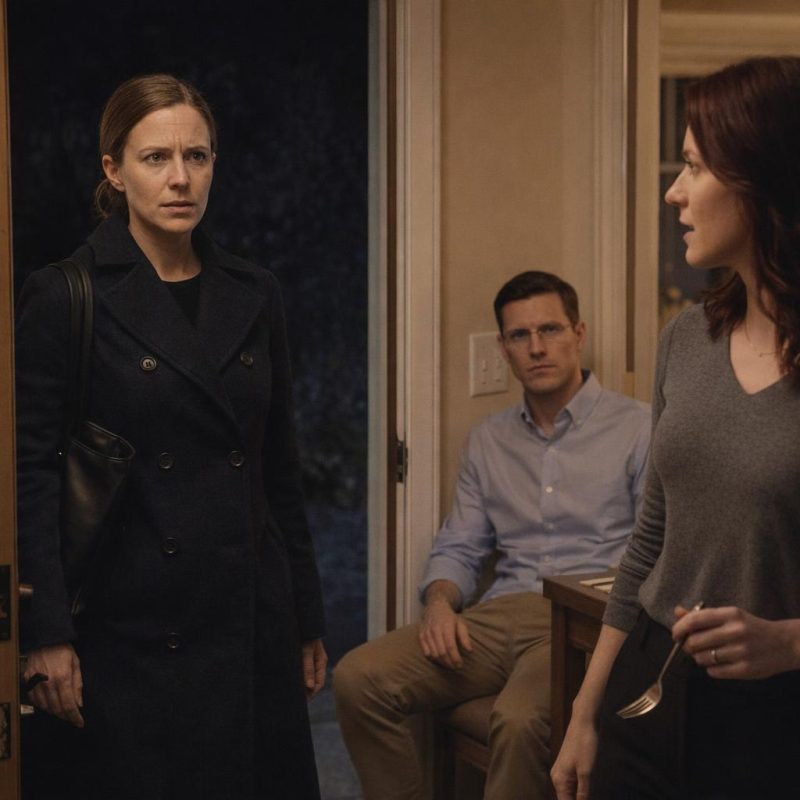 Image by RM AI
Four Months
She said it the way you'd read a line off a page — measured, like she'd practiced the cadence of it. She was pregnant. Four months. And the father was Mark. I remember the exact sound the room made after that, which was nothing. Mark stood up from the table so fast his chair scraped the floor. He said her name once, sharp, and then said that wasn't true, that it wasn't possible, that she needed to stop. Sarah didn't raise her voice. She didn't cry. She just stood there with her hands folded in front of her and let the words sit in the air between us. I was still holding my dessert fork. I don't know why I remember that detail, but I do — the small weight of it in my hand while everything else stopped making sense. I looked at Mark and his face was open and stunned in a way I'd never seen before, color draining out of it. I looked at Sarah and her expression was careful, composed, unreadable. I set the fork down on the table very slowly. The anniversary dinner sat between us — the good dishes, the half-empty bottle of Barolo, the lopsided torte — and none of it meant anything anymore. The silence that followed was the loudest thing in the room.
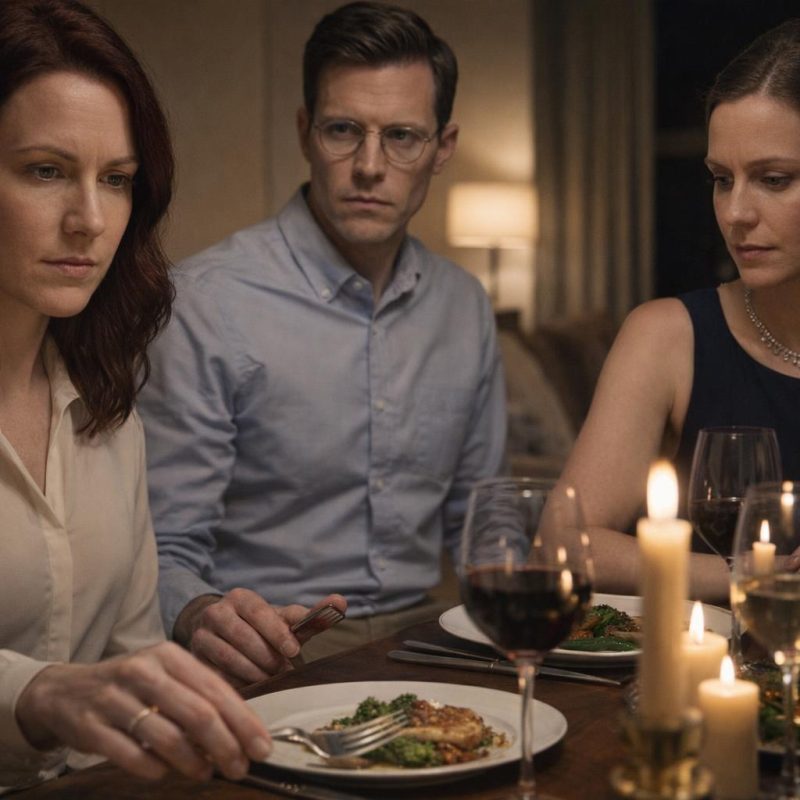 Image by RM AI
Evidence
Mark kept saying it wasn't true, kept saying it in different ways like one of them would finally land — that he'd never, that she was lying, that I had to know that. Sarah reached into her bag without rushing and pulled out a small envelope of printed photographs. She set them on the table the way you'd set down a receipt, matter-of-fact, no drama. I picked them up. The man in the photos had Mark's build, Mark's hair, Mark's glasses. The woman had Sarah's coloring, Sarah's hair. The setting was unmistakable — the guest house at the back of our property, the one we rented out occasionally, the one with the blue-gray couch and the particular way the afternoon light came through the side window. Mark leaned over my shoulder and said that wasn't him, that he'd never been in that house alone with her, not once. His voice was tight. Sarah sat down at our dining table — the one still set for our anniversary — and folded her hands and said nothing. She didn't need to. I turned the photos over one by one, looking for something I could point to, something that would make them obviously wrong. I couldn't find it. I just sat there with the photographs in my hands, not knowing what I was supposed to do with the weight of them.
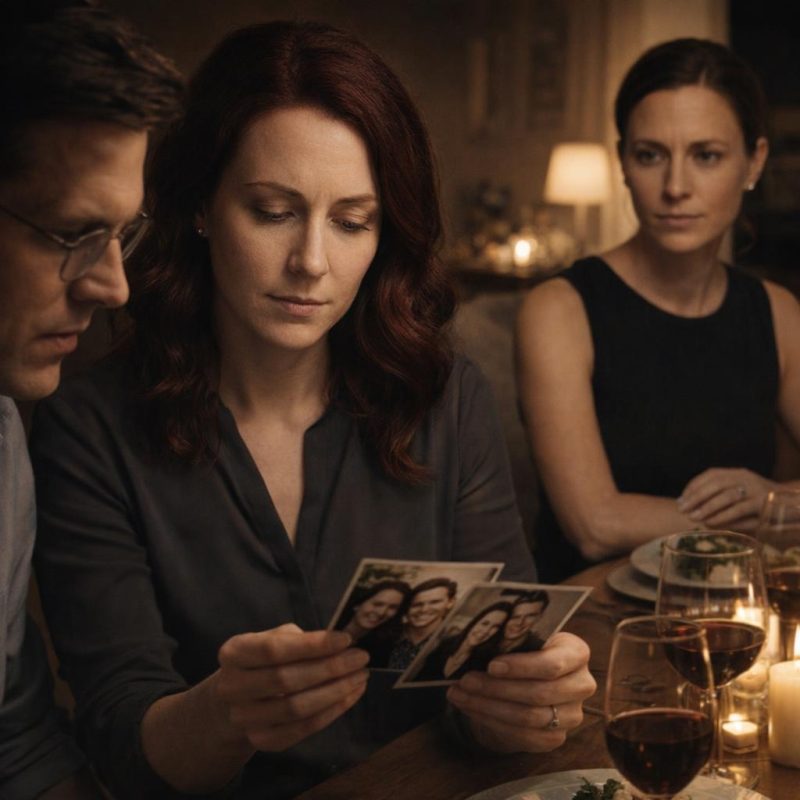 Image by RM AI
Messages
Sarah pulled out her phone next and turned the screen toward us. Screenshots of a text thread — the contact name at the top was just a string of letters I didn't recognize, but the number underneath it was one I knew. Mark's number. The messages were short and familiar in a way that made my stomach turn, the kind of shorthand you develop with someone over time. Mark grabbed his own phone off the counter and pulled up his messages, scrolling fast, saying the thread wasn't there, that he'd never sent any of it, that someone had to have spoofed his number. His voice had gone from stunned to something closer to desperate. Sarah was talking, gesturing with her hands to make some point about the timestamps, and that's when I saw it — a white plastic band around her left wrist, the kind hospitals put on patients at check-in. It had slipped out from under her sleeve when she moved her arm. I didn't say anything. I just watched it for a second, trying to read the small printed text on it without being obvious. The date printed on the bracelet was yesterday's.
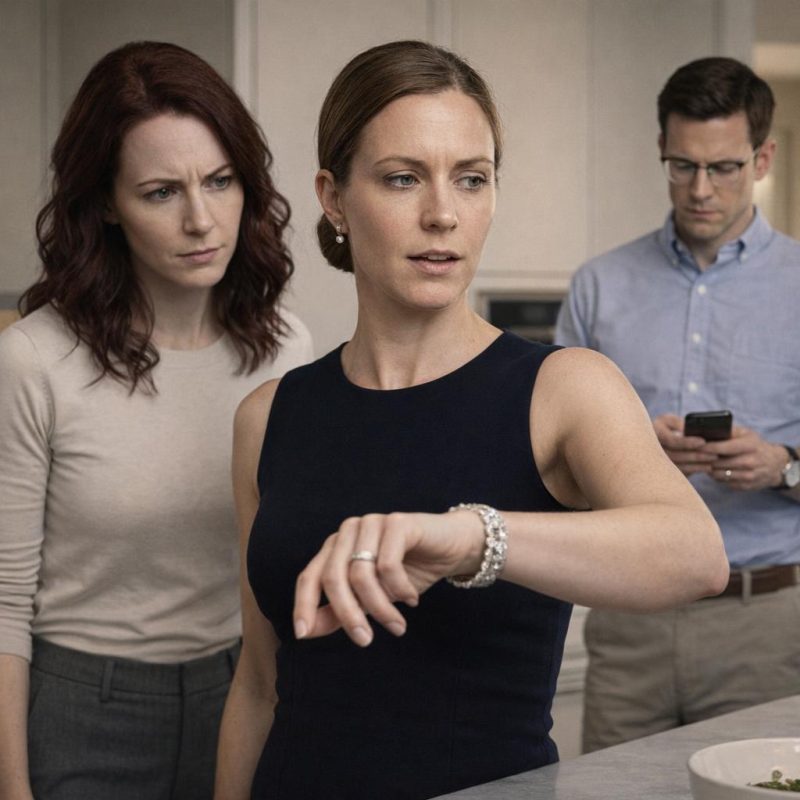 Image by RM AI
Guest House
After a few minutes I asked if I could look at the photos again. Sarah slid them back across the table without a word. I spread them out under the dining room light and went through them slowly this time, the way you read something twice when the first pass doesn't make sense. The guest house details were right — the couch, the lamp on the side table, the particular angle of the window. I'd been in that room enough times to know the layout without thinking about it. Mark pointed to one of the photos and said the alarm log would show every time that door had been opened, that we could pull the records and check. He said it quietly, like he was trying to be methodical instead of panicked. Sarah sat at the far end of the table and watched us without speaking. The timestamps on the photos were spread across several weeks, not a single night. I kept turning them over, looking at the edges, the lighting, the way the shadows fell across the furniture. Something about the shadows in the background of the last photo stayed with me — familiar in a way I couldn't quite name, like a detail I'd seen before in a different context, sitting just outside the reach of what I could put into words.
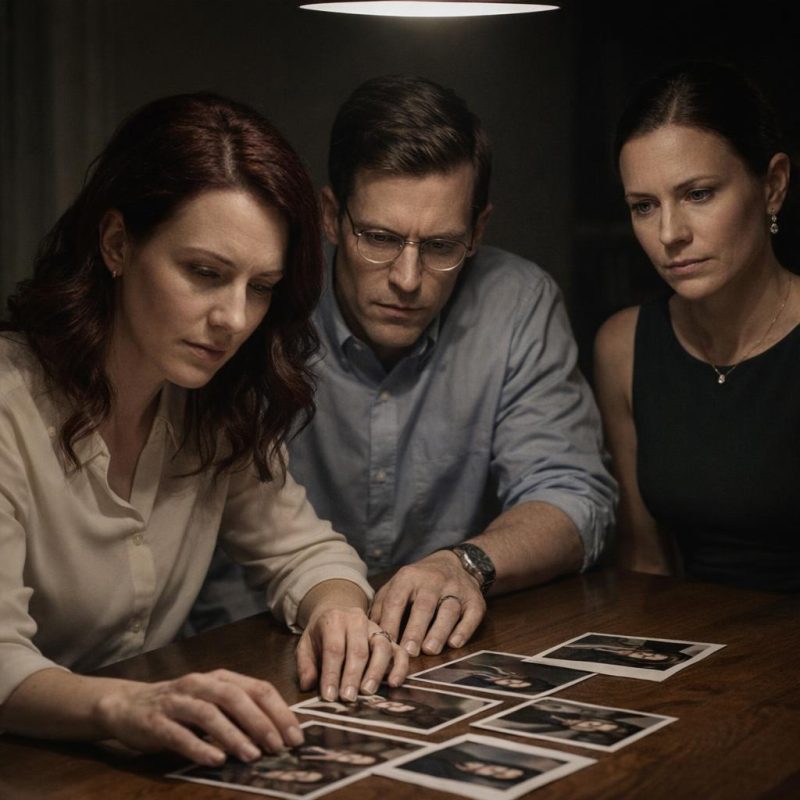 Image by RM AI
Alibi
Mark pulled up his work calendar and laid his phone flat on the table so we could both see it. He went through the dates on the photos one by one, cross-referencing each timestamp against his schedule. Two of them he could account for immediately — a client dinner downtown that ran until midnight, a Saturday we'd spent driving up to see his parents, which I remembered because we'd gotten stuck in construction traffic both ways. He was calm about it, methodical, the way he got when he was trying to think through a problem instead of react to it. Sarah sat at the other end of the table and didn't interrupt. Her expression didn't shift much either way. Mark scrolled to a third date — a Thursday in late October — and said he'd been in Seattle for a product review, that he'd flown out Tuesday and come back Friday. I remembered that trip. I'd eaten cereal for dinner two nights in a row because I hadn't bothered to cook for one. He turned the phone toward me so I could see the calendar entry, and then I looked back at the photo with that same Thursday timestamp, and the date on the photo and the date on his calendar were the same.
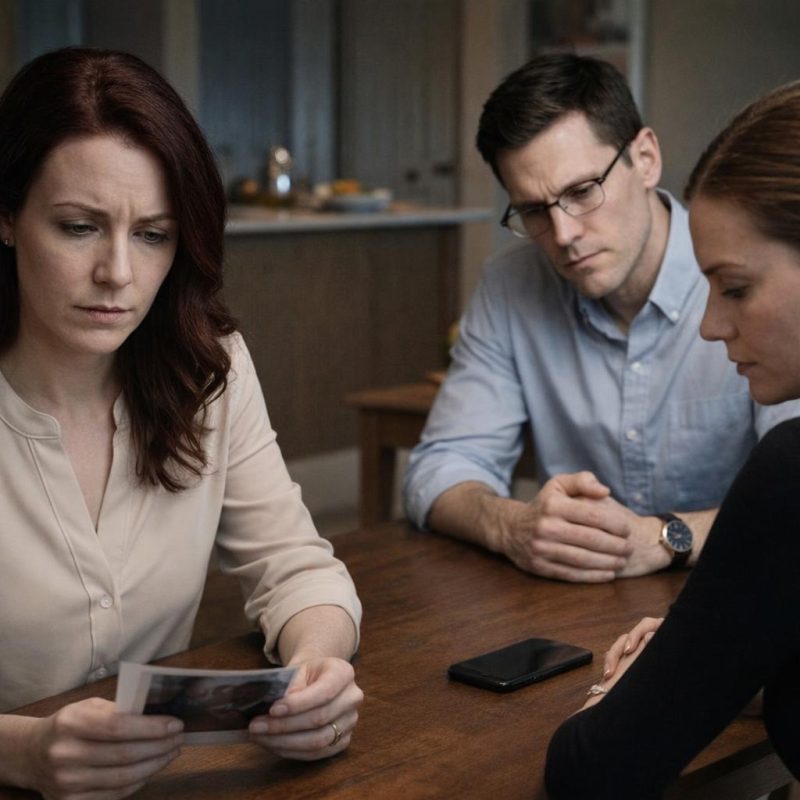 Image by RM AI
Outside Perspective
Sarah left around eleven without much ceremony — just picked up her bag, said she'd be in touch, and walked out the front door like she'd only stopped by to drop something off. Mark and I stood in the kitchen for a few minutes not saying anything useful. I told him I needed some air and some time to think, and he nodded like he understood, even though neither of us really knew what came next. I went upstairs and sat on the edge of the bed and called Rachel. She picked up on the second ring, which was lucky because I wasn't sure I could have held it together through voicemail. I told her everything — the doorbell, the photos, the text screenshots, the whole impossible evening — and my voice only broke once, somewhere around the part about the anniversary torte still sitting on the table downstairs. Rachel didn't panic and she didn't fill the silence with reassurances I didn't need. She asked about the photos first, whether the timestamps were embedded metadata or printed on the image. Then she asked about the texts, whether Mark had checked his carrier records. Then she paused and said, wait — go back to the bracelet. She asked what hospital name was printed on it, and whether the date I'd seen was an admission date or a discharge date.
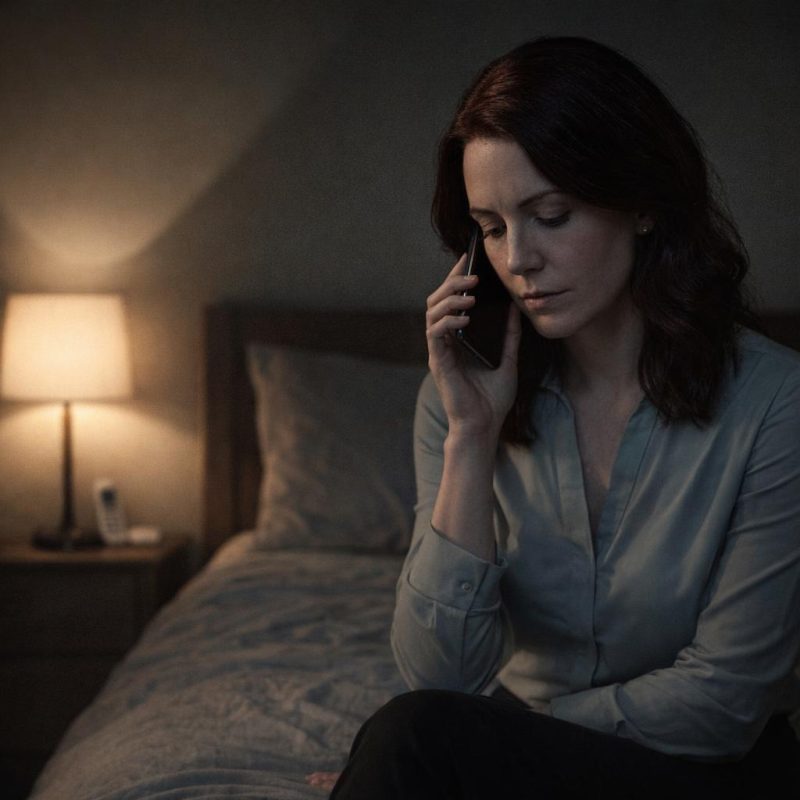 Image by RM AI
Sonogram
After Mark went upstairs I stood in the kitchen for a while, not really moving. The anniversary torte was still on the counter. I hadn't touched it. At some point I noticed the sonogram on the dining table — Sarah must have left it there on purpose, or maybe she just forgot it, I honestly couldn't tell. I picked it up. It was a standard printout, the kind you get from an ultrasound tech, slightly glossy, the image grainy in that familiar way. The medical facility name was printed across the top in small block letters. The fetus was curled in the usual position, measurements annotated along the edges in the usual clinical shorthand. I stood there under the kitchen light and looked at it for a long time, trying to feel something definitive, but mostly I just felt tired and strange. I turned it over, then back again. I told myself I didn't know enough about reading these things to draw any conclusions. Then I looked more carefully at the numbers printed along the bottom edge — the gestational measurements — and something about them made me stop.
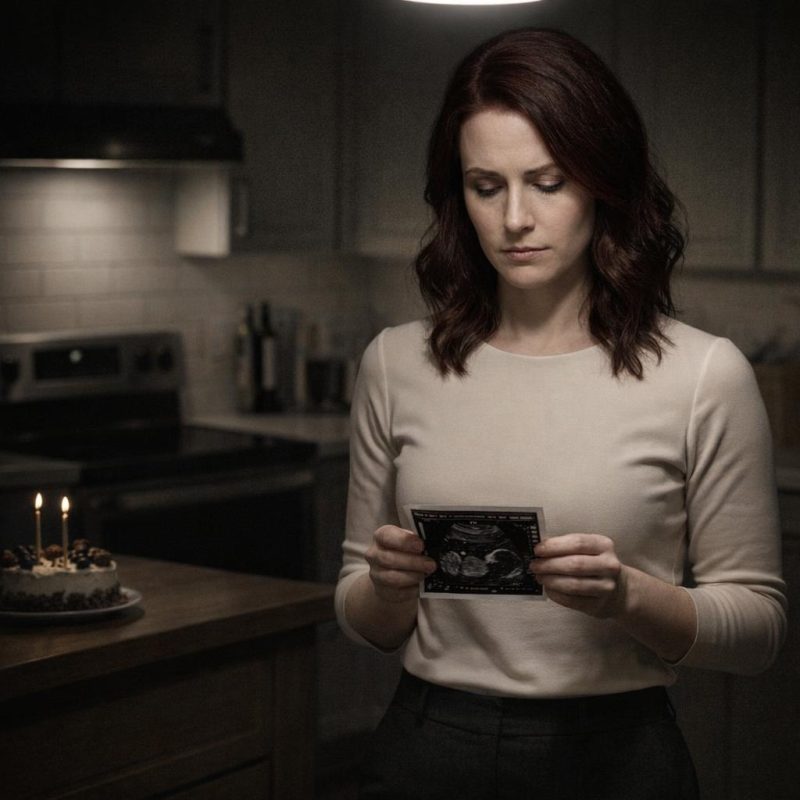 Image by RM AI
Anniversary
Mark was asleep by the time I came to bed, lying on his side with one arm stretched across his half of the mattress. I lay down next to him and stared at the ceiling and listened to him breathe. My mind kept circling back to the bracelet — the date printed on it in that small hospital font. I'd only glimpsed it for a second, but I have a good memory for numbers, always have. I kept turning the date over in my head, trying to place it, and then it landed. It was the same date as Danny's accident. Our younger brother. Seven years ago, a car accident on a wet highway, and we'd lost him before any of us had a chance to say anything that mattered. I lay very still beside Mark and let that sink in. Sarah had always struggled around that date — more than I had, maybe, or at least differently. She'd go quiet, or she'd go the other direction entirely and do something that scared us. I didn't know what to do with the coincidence. I wasn't sure it was a coincidence. The weight of that date, and everything it carried, settled over me in the dark.
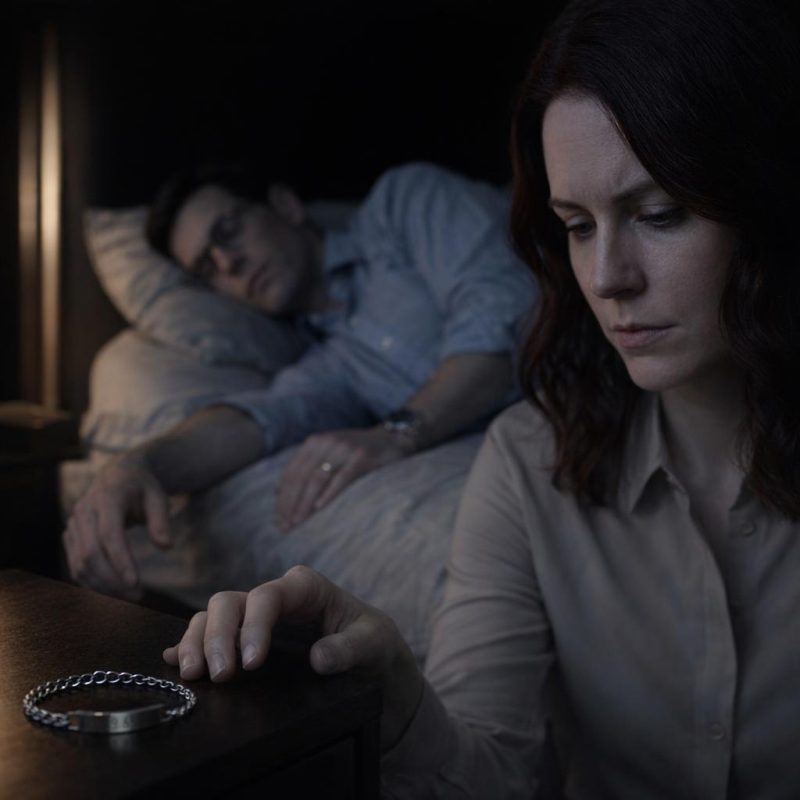 Image by RM AI
Digital Footprint
I waited until Mark's breathing went deep and even, then I reached across to his nightstand and picked up his phone. I knew his passcode — we'd never made a secret of those things — and I felt sick using it this way, but I unlocked it anyway. I went through his texts first, scrolling back four months, then five. Nothing from Sarah's number. Nothing that looked like a second phone or a coded exchange. I checked his email app, his calendar, his photo gallery. The calendar entries matched everything he'd told me — the Chicago conference, the client dinners, the gym sessions logged in neat little blocks. The photos were what I expected: job sites, a few pictures of us from a weekend trip in the spring, a blurry shot of a sunset he'd thought was worth keeping. I put the phone back exactly where I'd found it and lay down again. I felt relieved, and I felt ashamed of the relief, and underneath both of those things I felt something I couldn't quite name — because the absence of evidence wasn't the same as an answer, and I wasn't sure what I'd been hoping to find, or what it meant that I'd gone looking at all.
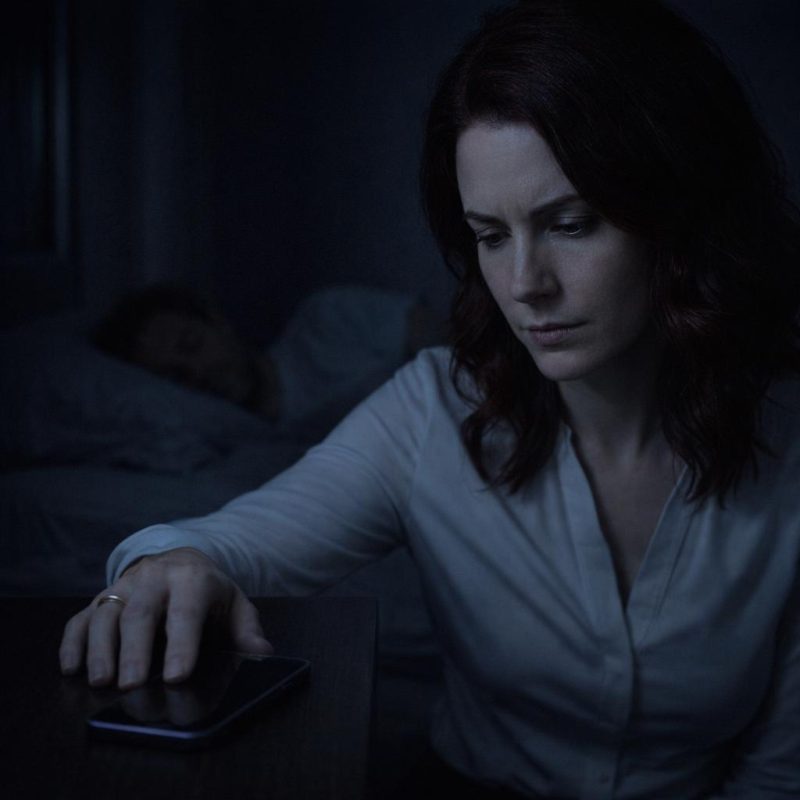 Image by RM AI
Mother's Call
My mother called at seven forty-five in the morning, which meant she'd been awake for a while working up to it. I was on my second cup of coffee and Mark was in the shower. I picked up. She started carefully, the way she does when she's already heard one side of something and is trying to seem neutral. She said Sarah had called her late the night before, that she was worried about her, that she just wanted to understand what had happened. I gave her the short version — the doorbell, the photos, the bracelet, the whole impossible evening — and she listened without interrupting, which was unusual. Then she said she wasn't taking sides. She said Sarah was going through something, that she'd seemed fragile lately, that family had to hold together even when things were hard. I told her I understood that. I told her I also needed her to understand that what Sarah had done had landed in the middle of my marriage. There was a pause. Then she asked me, in a voice that was careful and quiet, whether Mark had ever given me reason to doubt him.
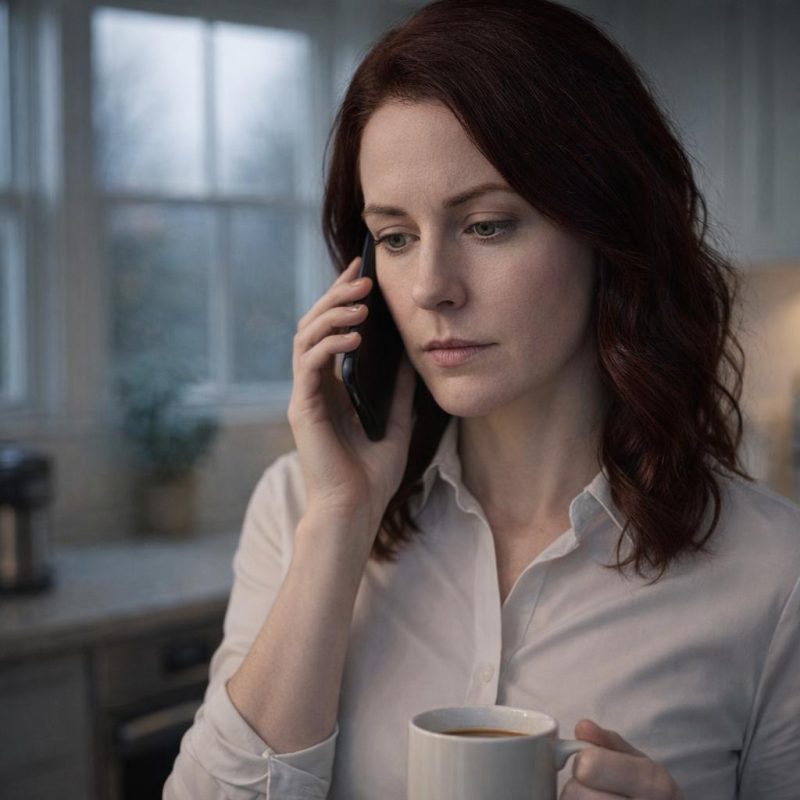 Image by RM AI
Backgrounds
I spread the photos across my desk in the home office and sat down with a notepad. I'd been through them emotionally the night before — this time I wanted to look at them like a problem. I started with the backgrounds. In the first photo, supposedly taken on a Tuesday afternoon in late September, the light coming through the window behind them was low and amber, the kind of light you get around six in the evening, not three in the afternoon. I wrote that down. In the second photo, there was a potted plant visible on the shelf in the background — a trailing pothos I recognized because I'd bought it at the farmers market in October and put it in the guest house myself. The photo was timestamped two weeks before I'd bought it. I wrote that down too. I went through each one methodically, noting shadows that fell the wrong direction, a window reflection that didn't match the supposed time of day. I made a column for each discrepancy. By the time I'd finished, I had seven entries on my notepad. I sat back and looked at the list, and the quiet in the room felt different from the quiet I'd started with.
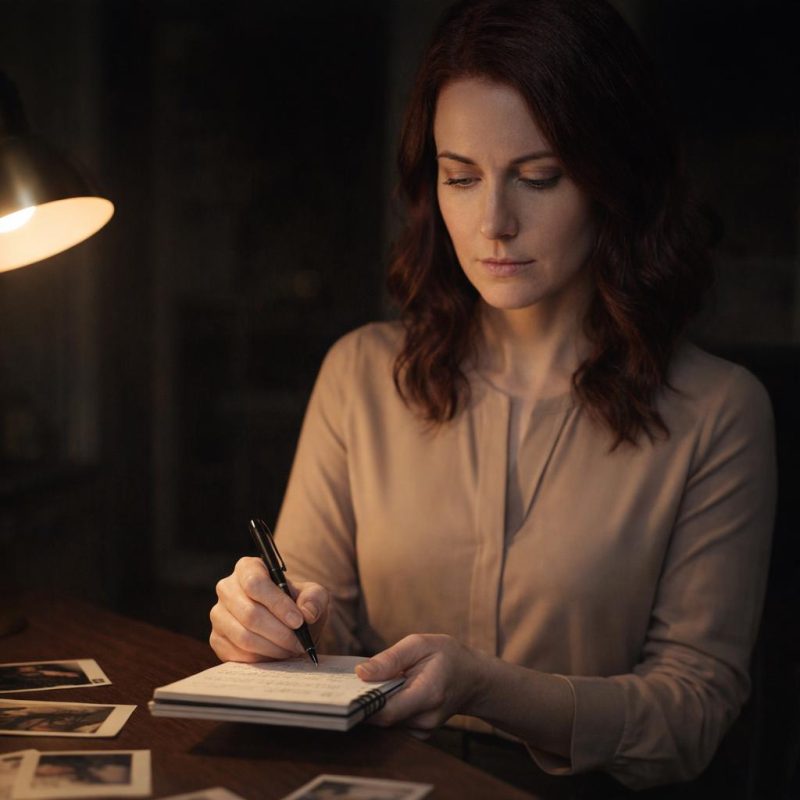 Image by RM AI
Bracelet
I kept coming back to the bracelet. Not the photos, not the texts — the bracelet, and that date. I sat at the kitchen table with my coffee going cold and let myself think about the anniversaries I'd watched Sarah move through over the years. Three years ago she'd called me at two in the morning, her words running together, not making sense. I'd stayed on the phone with her for an hour before she calmed down enough to sleep. Two years ago she'd gone completely silent — no calls, no texts, three days where none of us could reach her, and when she finally surfaced she acted like nothing had happened. Last year she'd shown up at our parents' house with bruises on her forearm she wouldn't explain, and our mother had quietly not asked. Each year the date came around and Sarah moved through it differently, but she always moved through it hard. The hospital bracelet suggested this year had been no different — maybe worse. I didn't know what to do with that. I wasn't ready to fold it into everything else she'd brought to my door the night before. But I sat there thinking about my sister and the particular weight she carried every year on that date.
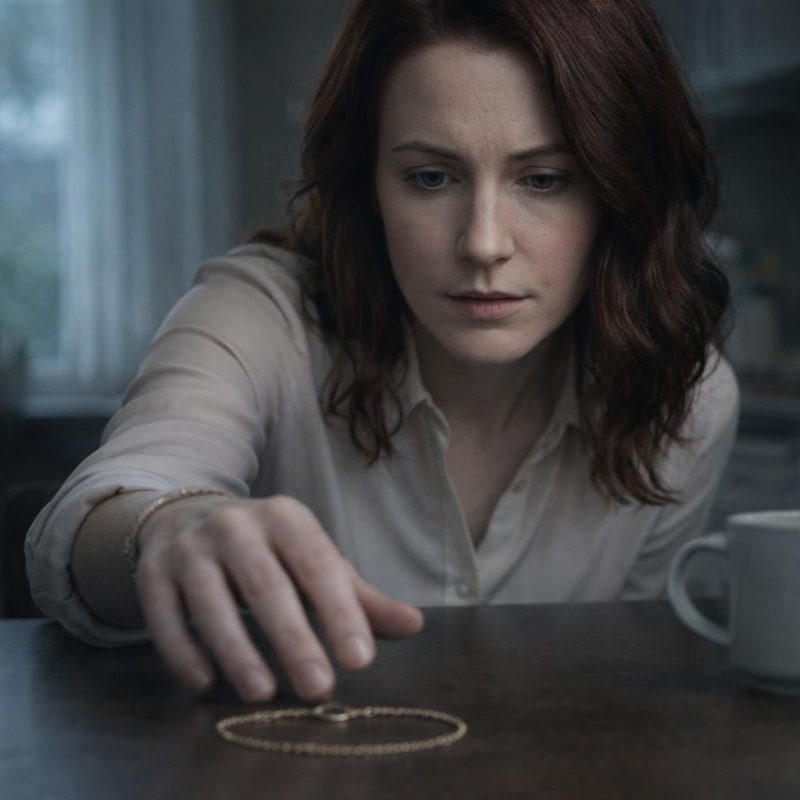 Image by RM AI
Timeline
Mark came downstairs around nine and I showed him what I'd started — a spreadsheet with every date from the photos and texts Sarah had presented, laid out in a column. He sat down across from me without hesitating and pulled his laptop over. We went through it together. He pulled up his credit card statements and we matched them against each date. The first photo, timestamped a Saturday in August — Mark had a hotel charge in Chicago from that entire weekend, conference registration included. I found the receipt in his email. The second date, a Wednesday in September — there were restaurant charges two miles from our house, a place we'd been to together, timestamped that same evening. His gym's check-in app had logged him at the location near our neighborhood on three of the other dates. We built the whole thing out, entry by entry, and the picture that emerged was consistent and ordinary and completely at odds with what Sarah had put on our table the night before. Mark didn't say anything triumphant about it. He just kept pulling up statements and handing me receipts. Then I opened the next statement and found a hotel charge from the weekend of the third photo — a Chicago hotel, two states away from where the photo claimed he'd been.
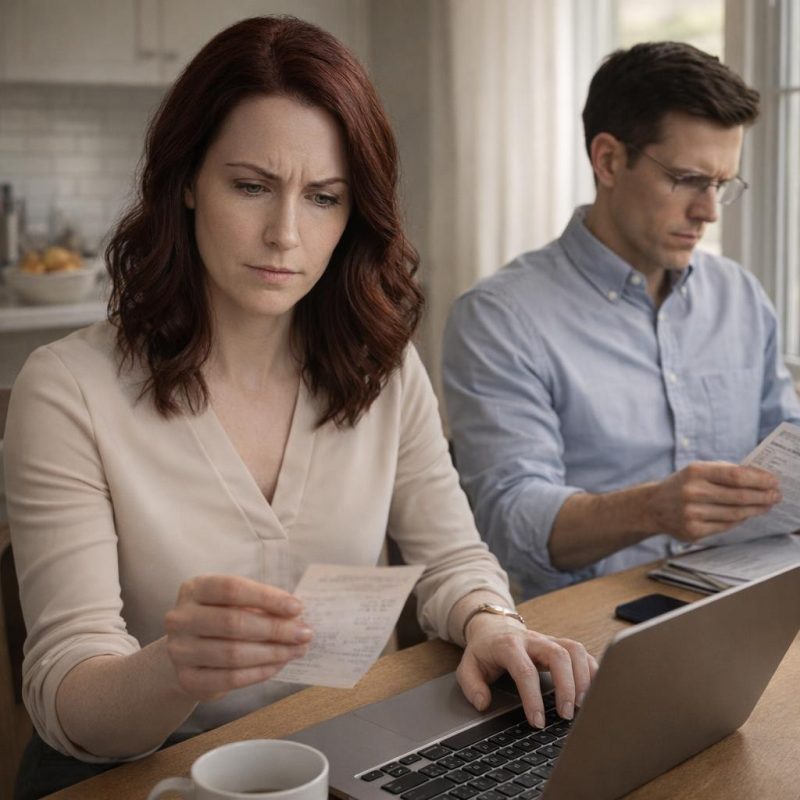 Image by RM AI
Jealousy
I stepped away from the spreadsheet and stood at the window for a while, not really seeing the yard. My mind had drifted somewhere older. I was thinking about the college application essay — I'd worked on mine for weeks, read it to Sarah one night because she'd asked, and then found out months later that she'd submitted something so close to it that our high school counselor had flagged it. Sarah had been sixteen. Our mother had called it flattery. I thought about the boy I'd mentioned liking junior year, just once, in passing, and how two weeks later Sarah had shown up to school holding his hand. I thought about how she'd declared the same major I had when she started college, then left after one semester without explanation. These things had always been handed back to me as compliments, as the natural behavior of a younger sibling who looked up to her older sister. I'd mostly accepted that framing. But the one that stayed with me — the one I kept returning to — was the morning of my college interview at Northwestern. I'd laid out my outfit the night before. When I came downstairs, Sarah was standing in the front hallway wearing it.
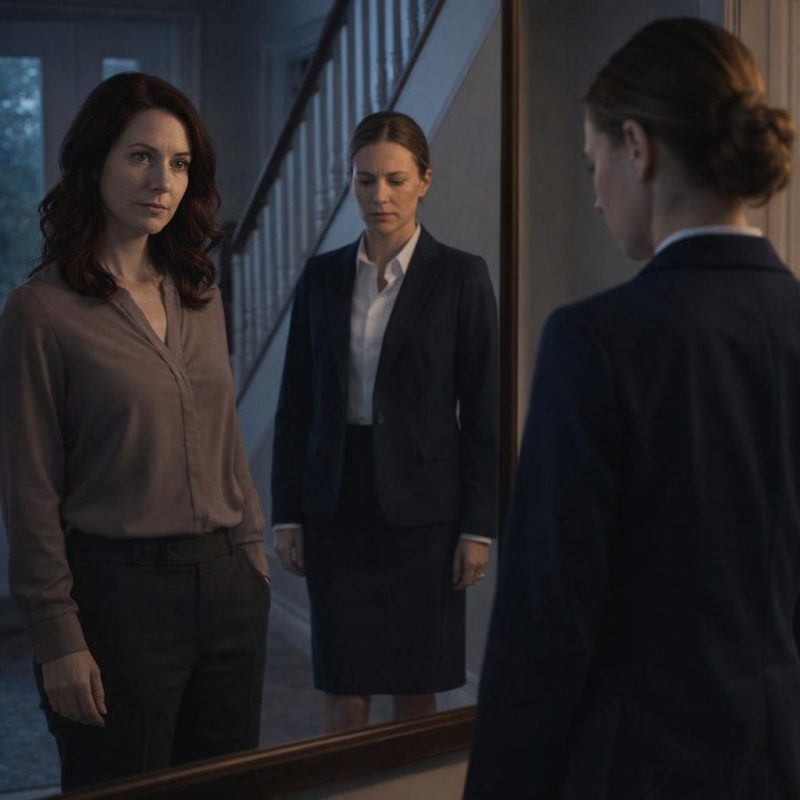 Image by RM AI
Familiar Numbers
I picked up the sonogram again. I'd looked at it a dozen times already, but this time I sat down at the desk and really looked — not at the image itself, but at the numbers printed along the margins. Crown-rump length. Gestational sac diameter. The specific millimeter measurements typed in that clinical font. Something about them nagged at me in a way I couldn't quite name. I'd seen those numbers before. Not similar numbers — these exact numbers. I turned the paper over, then back again, trying to chase down the memory. It felt like trying to remember a dream, the harder I reached for it the further it slipped. Then it came to me, not fully formed but enough: I had records from my own first trimester, years ago. I'd kept everything from that pregnancy in a box somewhere, the kind of careful record-keeping you do when something matters that much. I hadn't opened that box in years. I set the sonogram down on the desk and walked to the hallway closet, scanning the upper shelf until I found it — a cardboard box with my name written across the side in my own handwriting.
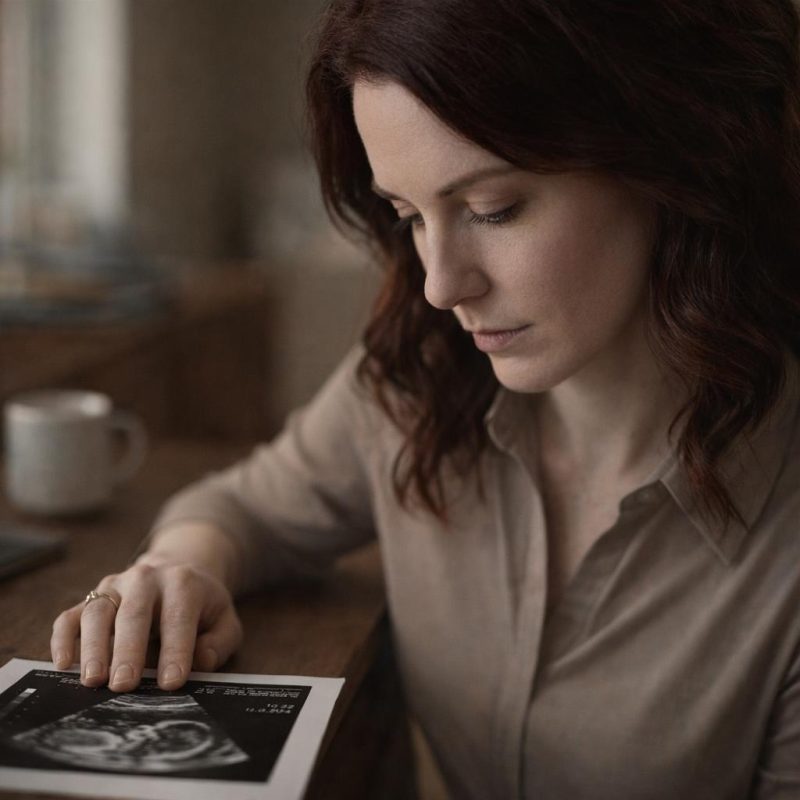 Image by RM AI
Records
I carried the box to the guest room and set it on the bed. The flaps were sealed with packing tape that had gone brittle at the edges, and I had to work at it for a moment before it gave. Inside, everything was layered the way I'd packed it — carefully, like I'd known I might need to find things again someday. Vaccination records on top, then dental files, then a thick envelope of insurance statements I'd kept for tax purposes. I set each one aside in a neat stack. The pregnancy records weren't there. I checked twice, lifting each folder and fanning through the pages. Nothing. I pushed the first box aside and stood on the step stool to reach the second one, a smaller box pushed to the back of the shelf behind a winter coat. I pulled it down and set it beside the first. My hands had gone a little unsteady, which surprised me. I wasn't sure yet what I was looking for, not exactly — just a feeling that something needed to be checked, that the numbers on that sonogram deserved an answer I didn't have yet. I opened the second box and started sorting through it, and the quiet of the room settled around me like something with weight.
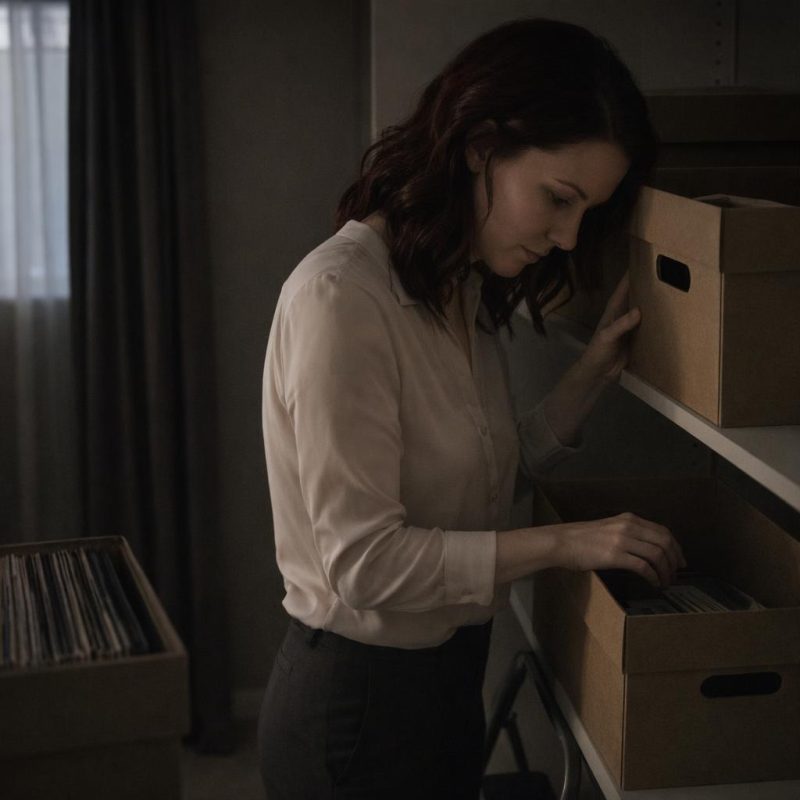 Image by RM AI
Match
The pregnancy file was near the bottom, tucked inside a manila envelope I'd labeled in blue marker. I recognized my own handwriting immediately. I pulled it out and set it on the desk beside Sarah's sonogram, then opened the envelope slowly. My first trimester records were all there — the lab work, the intake forms, and near the back, my own sonogram printout from six years ago. I placed it next to Sarah's. For a moment I just looked at both of them without moving. Then I started comparing the measurements printed along the margins. Crown-rump length: identical. Gestational sac diameter: identical. I checked the annotations in the corners, the specific medical codes typed beneath the image. They matched. Not approximately — exactly, down to the last decimal point. I went through every number on both pages twice, then a third time, telling myself I was misreading something, that two sonograms from different pregnancies could share measurements by coincidence. But the codes were the same. The font was the same. Even the small notation in the lower left corner was the same. I set both pages flat on the desk and sat back in the chair, and the two identical documents just sat there in front of me, not asking anything, not explaining anything — just there.
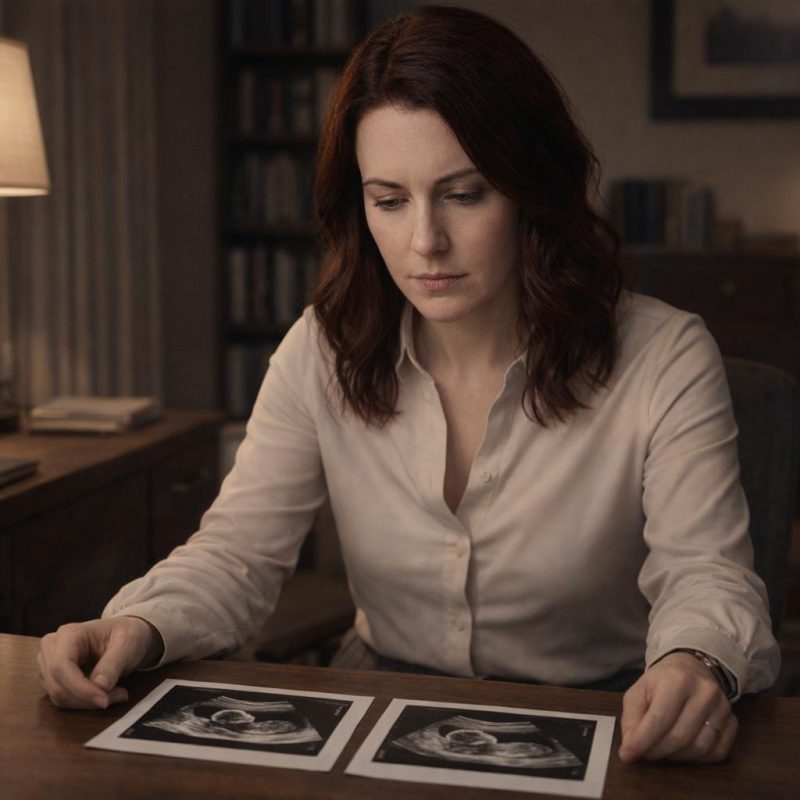 Image by RM AI
Access
I found Mark in the kitchen and asked him to pull up the guest house security logs. He looked at me for a second before he nodded and got his laptop. Our system was one of those cloud-based setups that logged every door access with a timestamp — we'd installed it two years ago after a contractor left a gate unlocked. Mark pulled up the interface and handed the laptop to me, then leaned over my shoulder while I navigated to the log history. I typed in the first date from the photos Sarah had shown us. Nothing. I tried the second date. Nothing. I went through all of them, one by one, reading each result aloud so Mark could hear it too. The system showed scheduled maintenance in March, a delivery confirmation in April, and nothing else. No entries for any of the dates Sarah had named. Mark straightened up and took his glasses off, rubbing the bridge of his nose. "The system's been running the whole time?" he asked. I clicked over to the diagnostics tab and checked the uptime record. It had been running continuously, no gaps, no resets. I scrolled back through the full log for the relevant months, and the entries for every date Sarah had described were completely blank.
 Image by RM AI
Empty Entries
We sat at the kitchen table with the laptop between us and went through the logs a second time, then a third. Mark pulled up the cloud backup on his phone to cross-reference, reading timestamps aloud while I tracked them on the laptop screen. They matched perfectly. The system hadn't malfunctioned. There were no missing data windows, no corrupted entries, no gaps where a record might have been lost. Every door access for the past eighteen months was accounted for, and the guest house door had not been opened on any of the dates Sarah had described. Mark set his phone down and didn't say anything for a while. I didn't either. There wasn't much to say that the logs hadn't already said more plainly than either of us could. I thought about the sonograms still sitting on the desk in the other room. I thought about the measurements, the matching codes, the identical notation in the lower left corner. None of it fit together into a shape I could name yet, but the pieces were accumulating in a way that felt harder and harder to set aside. Mark reached over and closed the laptop without a word. The quiet that settled over the kitchen after that felt different from ordinary quiet — heavier, like it was holding something neither of us was ready to say out loud.
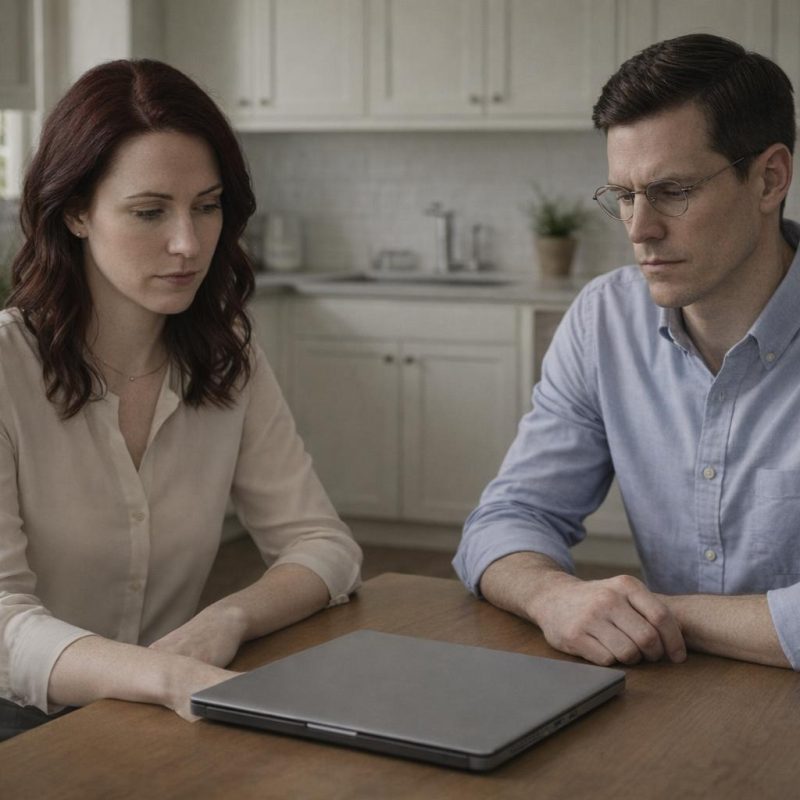 Image by RM AI
Quiet Investigation
I told Mark I didn't want to call Sarah yet. He looked like he wanted to argue — I could see it in the set of his jaw — but he let me finish. I explained that we had pieces, not a picture, and that if we moved too fast and got something wrong, we'd lose whatever advantage we had. He was quiet for a moment, then said, "Okay. You lead." I appreciated that more than I told him. We agreed not to say anything to anyone else — not Rachel, not my mother, not anyone — until I had a clearer sense of what we were actually dealing with. After Mark went to bed, I sat at the desk with my laptop and opened a new document. I titled it nothing, just left the cursor blinking at the top of the page, and then I started typing. The sonogram measurements. The security log dates. The hospital bracelet. The timing of Sarah's appearance at the party. Each item got its own line, and I left space beneath each one for notes, for questions, for whatever I hadn't thought of yet. It wasn't much to look at. But seeing it laid out in a list — concrete, specific, each item with a date attached — felt like the first solid ground I'd found since the night of the anniversary dinner.
 Image by RM AI
Hospital
I waited until Mark had left for work before I made the call. I'd written out what I wanted to say on a notepad first, keeping it general, nothing that would give away why I was asking. The hospital name was printed on the bracelet in small blue letters, and I'd looked it up the night before — a regional medical center about forty minutes from Sarah's apartment. I called the main line and asked to be transferred to patient services. A woman answered on the third ring, pleasant and efficient. I told her I was trying to understand how patient identification bracelets were issued — whether they were used for all visits or only certain types. She explained that the emergency department issued them for every patient, and that certain outpatient procedures required them as well, depending on the department. I asked, carefully, whether a family member could request access to a patient's records. She walked me through the standard process — written authorization, HIPAA forms, the patient's own consent required in most cases. I thanked her and ended the call. I sat for a moment with the notepad in my lap, the pen still in my hand. I hadn't learned anything specific about Sarah's visit, which was exactly what I'd expected. But I'd asked the questions calmly, in a voice I barely recognized as my own — measured and even, giving nothing away.
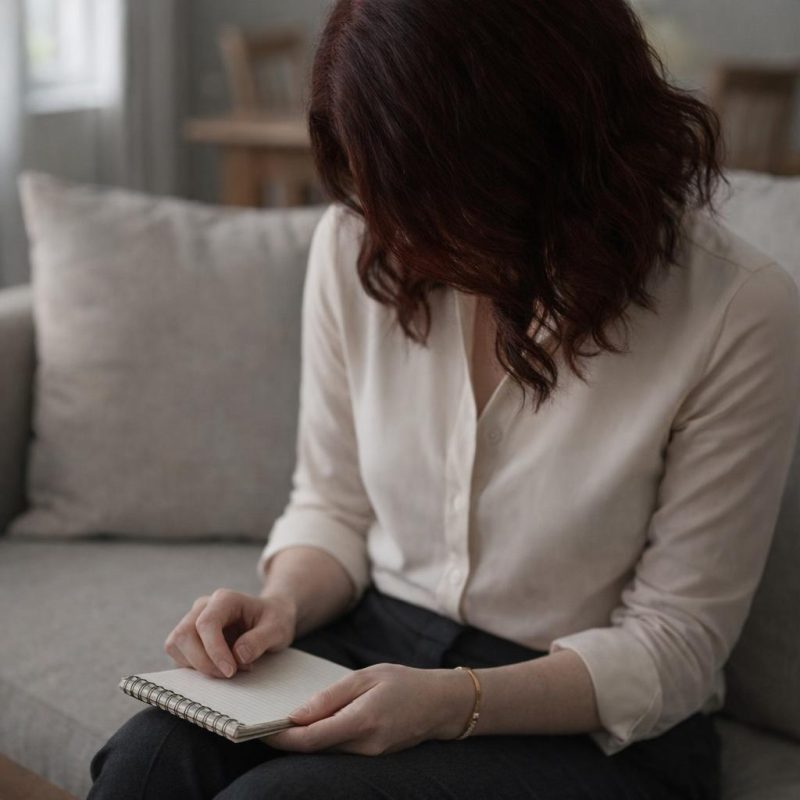 Image by RM AI
Anniversary Date
That evening I opened my calendar to the date of our anniversary party and sat with it for a while. Then I flipped back through the years, the way you do when something is pulling at you and you're not sure why. I started writing notes in the margins — small things I remembered about Sarah around that same date each year. The year she'd called me from a parking lot at two in the morning, crying so hard I couldn't understand her. The year she'd shown up at our mother's house unannounced and stayed for a week without explanation. The year she'd been hospitalized briefly — our mother had called it exhaustion, and I'd accepted that. I hadn't connected any of these moments to each other before, not consciously. But sitting there with the calendar open across my lap, I found myself writing the same date over and over in the margins. Then I remembered something I hadn't let myself think about in a long time: Sarah's twin brother had died when they were nine years old. The anniversary of his death fell in the same week as our party. I sat with that for a long time, the calendar open, seven years of margin notes spread across my lap, the pattern of it quiet and heavy and sad.
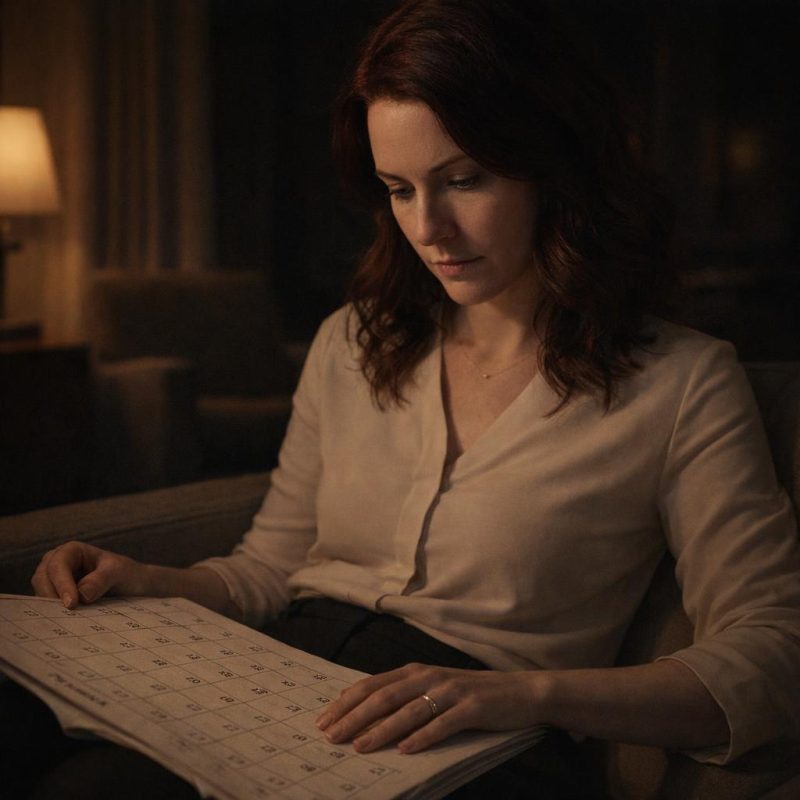 Image by RM AI
Twin
I pulled the old photo albums out of the hall closet around midnight, the ones my mother had pressed into my hands when I moved out and I'd never quite found a reason to open. They smelled like the house I grew up in — a little dusty, a little sweet. I sat on the floor with them spread around me and started turning pages. There were the usual childhood pictures: birthday cakes, Christmas mornings, a summer at the lake I barely remembered. And then there was Danny. Sarah's twin. They were everywhere together — same gap-toothed smiles, same way of tilting their heads in photos, same instinct to reach for each other's hand. I'd been seven when they were born, old enough to watch them grow up as a unit, a closed circuit of two. I remembered the year Danny died — the accident, the weeks Sarah spent barely speaking, the way she'd told me once, quietly, that she should have been in that car too. I'd never known what to do with that. I still didn't. I sat there turning pages until I found the one I'd been half-looking for without knowing it: Sarah and Danny at twelve years old, their faces so alike they looked like reflections of each other in a mirror.
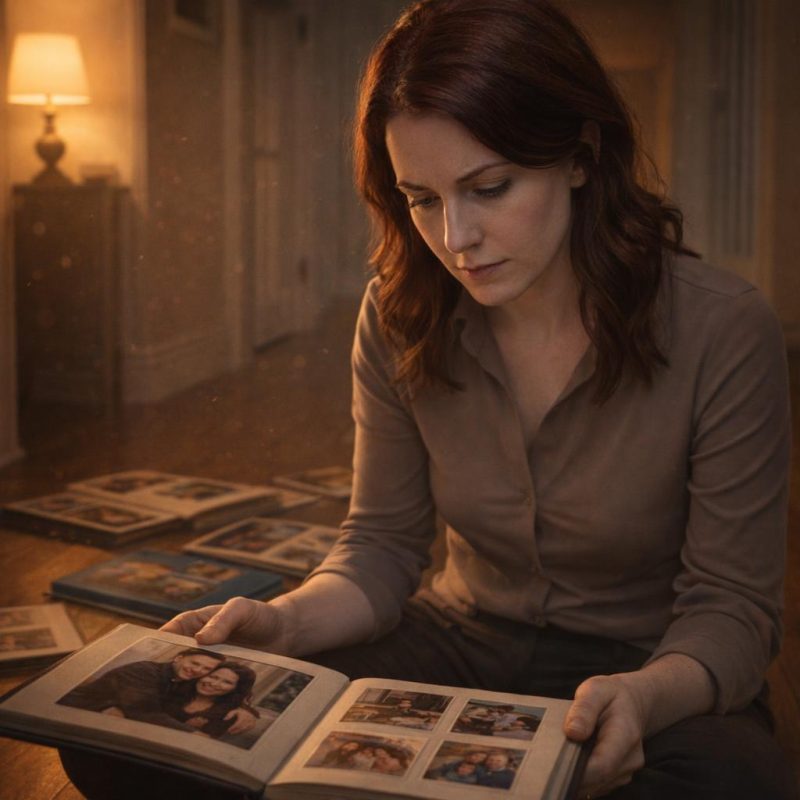 Image by RM AI
Rachel's Advice
I called Rachel the next morning before I'd even made coffee. She picked up on the second ring, which was so like her that I almost laughed. I told her everything — the security log gaps, the sonogram that matched the one I'd found online, the calendar pattern I'd noticed going back seven years. She listened without interrupting, which was also very Rachel. When I finished, there was a short pause. 'Okay,' she said. 'Walk me through the sonogram thing one more time.' So I did. She asked three or four careful questions — the kind that made me feel like she was building something in her head, not just reacting. Then she said, 'Mara, I think you need to talk to an attorney. Not because you're in trouble. Because you need someone who can tell you what this actually means legally.' I'd been thinking the same thing but hadn't wanted to say it out loud. Hearing her say it made it feel less like panic and more like a reasonable next step. She offered to ask around for a family law referral, someone she trusted. I told her yes. After we hung up, I sat at the kitchen table with my coffee going cold, and the steadiness in her voice was still there with me, like something solid I could lean against.
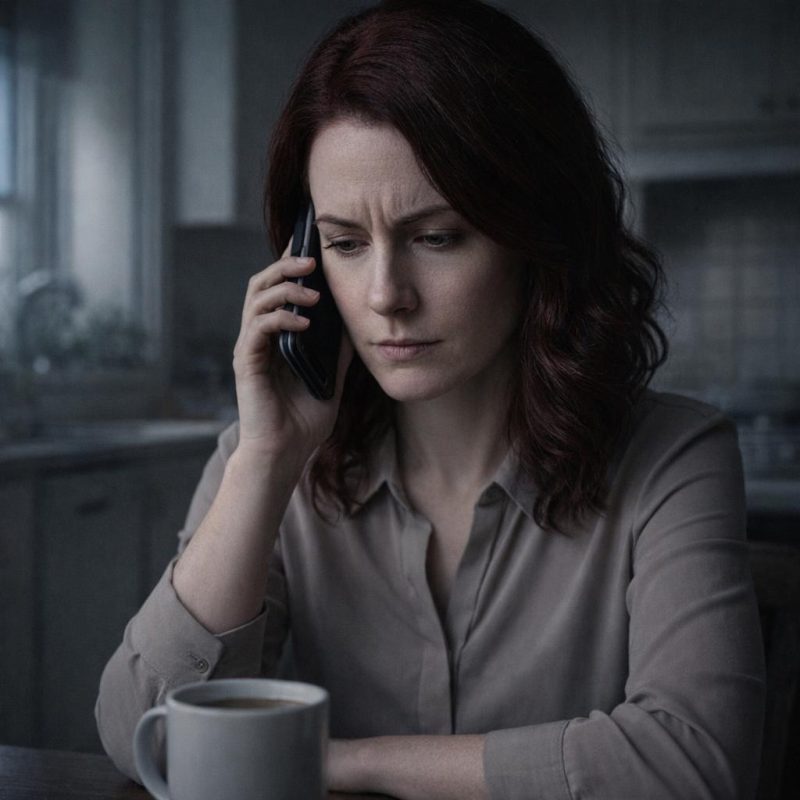 Image by RM AI
Documentation
That afternoon I opened a new document on my laptop and started at the beginning. I listed every piece of evidence in chronological order: the photo metadata I'd checked, the security log gaps, the sonogram image and the source I'd traced it to, the hospital bracelet date, the calendar pattern going back seven years. I pulled up Mark's credit card statements and added the relevant dates — dinners, gas stations, a work conference two states away — all of it timestamped and verifiable. I added screenshots. I added notes in brackets where I wasn't certain, flagging what was confirmed versus what was still a question. It took three hours. By the end, the document was eleven pages and I felt something I hadn't expected: not relief exactly, but a kind of grim steadiness, like I'd finally stopped running from something and turned around to face it. I formatted it carefully, added a table of contents, and saved it to an encrypted folder. Then I paused at the password prompt and typed in the one Mark and I had used for years — the one we'd made up together on our first trip abroad, the one nobody else would ever guess — and locked the file.
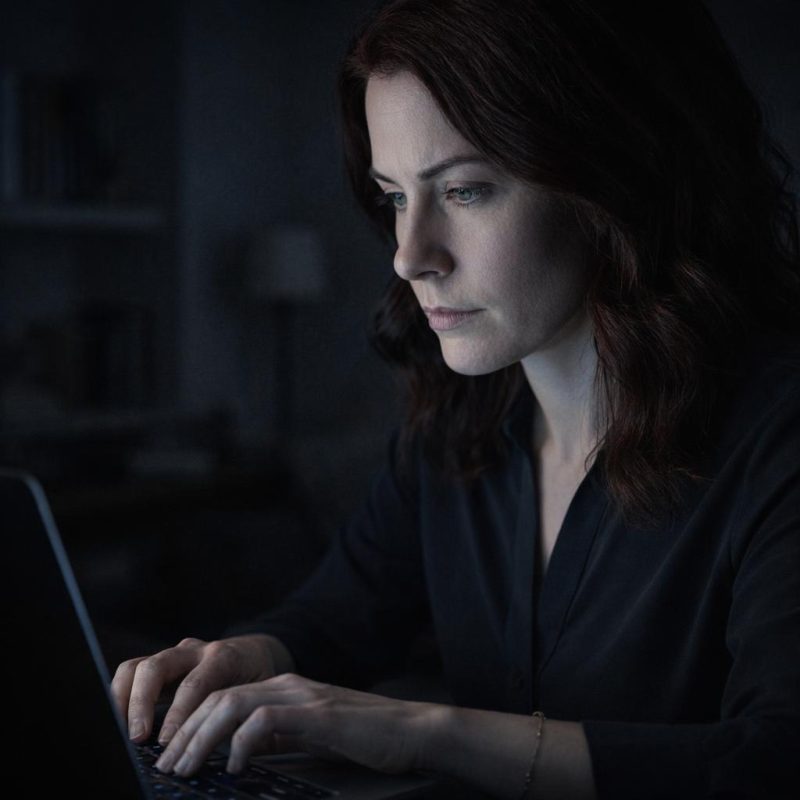 Image by RM AI
Attorney
Nicole's office was on the fourteenth floor of a building downtown, all clean lines and quiet carpet. Her assistant showed me in without much preamble, and Nicole was already standing when I entered — sharp-featured, auburn hair, a tailored jacket that made her look like someone who did not lose arguments. I set my folder on the table and she sat down across from me and said, 'Tell me everything, and don't edit.' So I did. I talked for almost twenty minutes. She didn't interrupt. She took notes in a small, precise hand. When I finished, she asked to see the documentation, and I slid the folder across. She went through it page by page, pausing at the sonogram comparison, pausing longer at the security log printout. She asked two questions about the metadata. Then she set the folder down and looked at me steadily. 'What you're describing,' she said, 'the fabricated images, the falsified dates, the manufactured evidence presented to damage your marriage — that's not just a family dispute.' She tapped the folder once with two fingers. 'If this holds up, what your sister did could constitute fraud.'
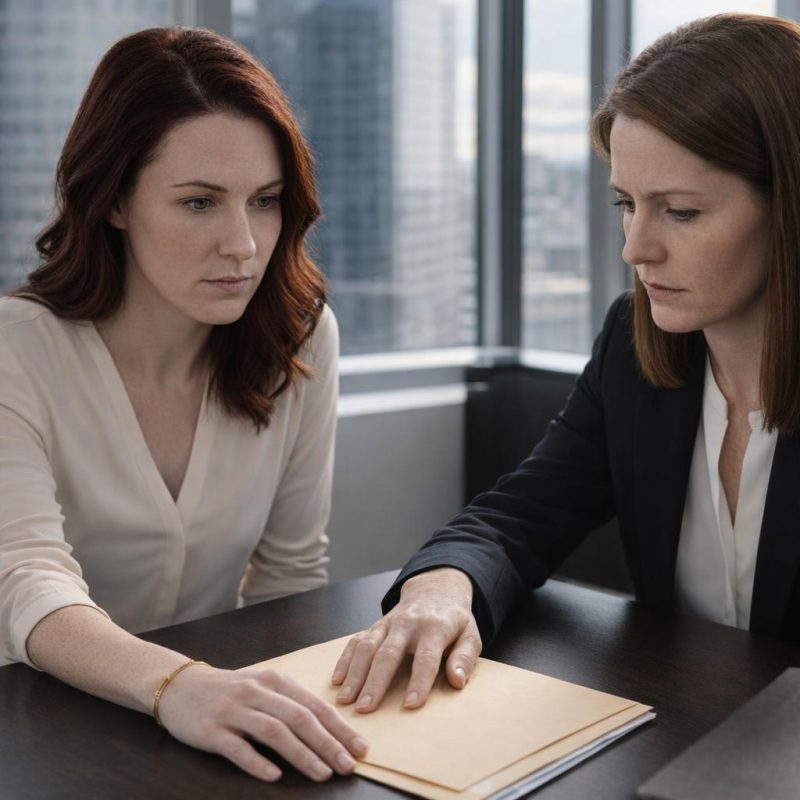 Image by RM AI
Forensic Analysis
Nicole let the word settle for a moment before she kept going. She explained that proving it would require more than my own analysis — that my observations were a strong starting point, but that a court, or even a mediator, would need something harder. That's when she mentioned the forensic analyst. She said he'd worked on half a dozen cases involving manipulated digital evidence, that he'd testified as an expert witness, and that he had a particular specialty in photo metadata and composite image detection. She walked me through what the process would look like: I'd send him the original files, he'd examine the metadata layer by layer, check for signs of editing software, look for inconsistencies in lighting and pixel data that the naked eye couldn't catch. It would take several days, maybe a week. There were no guarantees, she said, but if the images had been altered, he would find it. I told her I wanted to move forward. She nodded like she'd expected that, pulled a business card from a small holder on her desk, and slid it across the table to me.
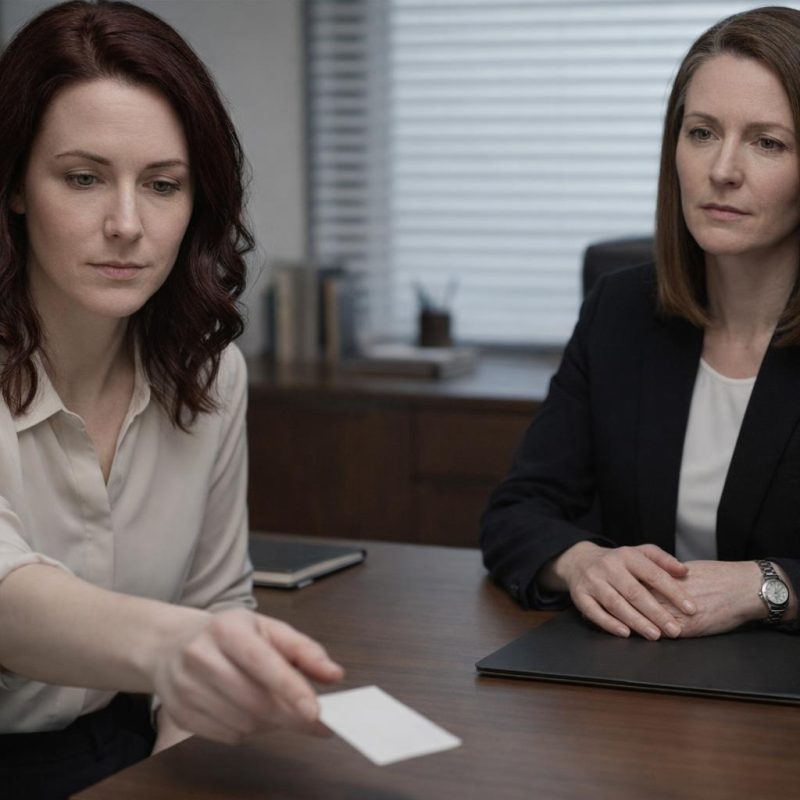 Image by RM AI
Metadata
The analyst called four days later, on a Tuesday afternoon. Mark was home — he'd taken the afternoon off, and we'd been sitting at the kitchen table not quite talking when my phone rang. I put it on speaker without thinking, and we both leaned in. The analyst's voice was measured and unhurried. He said he'd completed his preliminary review and wanted to share what he'd found so far. Multiple images showed signs of layering — areas where the pixel data didn't match the surrounding image, consistent with compositing from separate source photos. The metadata on three of the files showed creation timestamps that didn't align with the dates embedded in the image filenames. One file had been opened and re-saved in an editing application eleven days before it was supposedly taken. He said the full written report would be ready within two days. When the call ended, Mark and I sat there without speaking for a moment. I looked at the table. He looked at me. The relief and the anger arrived at the same time, and I couldn't have told you which one was heavier — I just sat with both of them, not moving.
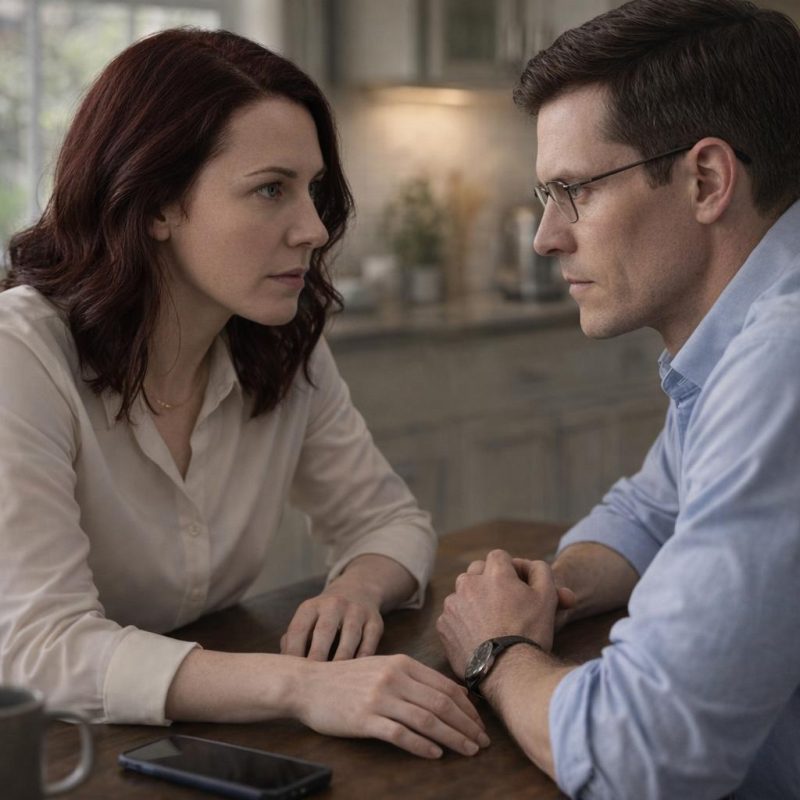 Image by RM AI
Social Media
I spent the next evening going through Sarah's social media accounts — Instagram first, then Facebook. I told myself I was looking for anything: a mention of a doctor's appointment, a photo that showed a visible pregnancy, a comment from a friend congratulating her. I scrolled back six months, then a year. There was nothing like that. Her posts were ordinary — a work happy hour, a weekend hike, a flat-lay of a book and a coffee cup. In every photo she looked the same: slim, composed, smiling the way she always smiled for cameras. No bump. No cryptic captions. No tagged locations at medical offices. What I noticed instead was the absence of things. She'd been posting less frequently over the past six months — not dramatically, but enough that the gaps were visible once I was looking for them. Weeks would pass with nothing, then a cluster of carefully chosen images would appear. I couldn't say what that meant. Maybe nothing. But I kept scrolling anyway, and the longer I looked, the more I felt the weight of how much effort had gone into making everything look completely unremarkable.
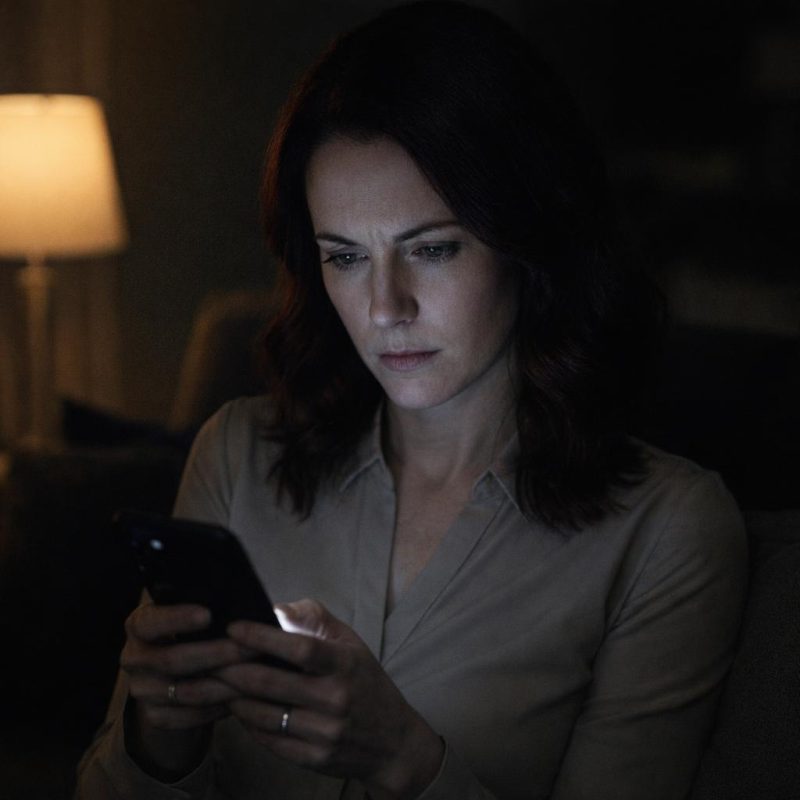 Image by RM AI
Photographs
The next afternoon I spread family photos across the dining room table — printed ones from the albums, screenshots I'd saved from her social media, a few I'd pulled from my own phone. I wasn't sure what I was looking for at first. I just started arranging them by year, the way you'd lay out a timeline. The older photos were easy: Sarah at twenty, twenty-two, twenty-five. Then I started looking at the recent ones more carefully. Something about her face looked different, though I couldn't settle on what exactly — maybe the way the light caught her features, maybe something about her expression, or the way she held herself in front of a camera now compared to before. I kept second-guessing myself, wondering if it was just the angle or the lighting or a change in how she did her makeup. People changed. I'd probably just stopped paying close attention. I kept moving photos around, trying to find the right comparison, until I reached the back of the pile and pulled out a photo from two years ago — the two of us at our mother's birthday dinner — and set it next to the most recent one I had.
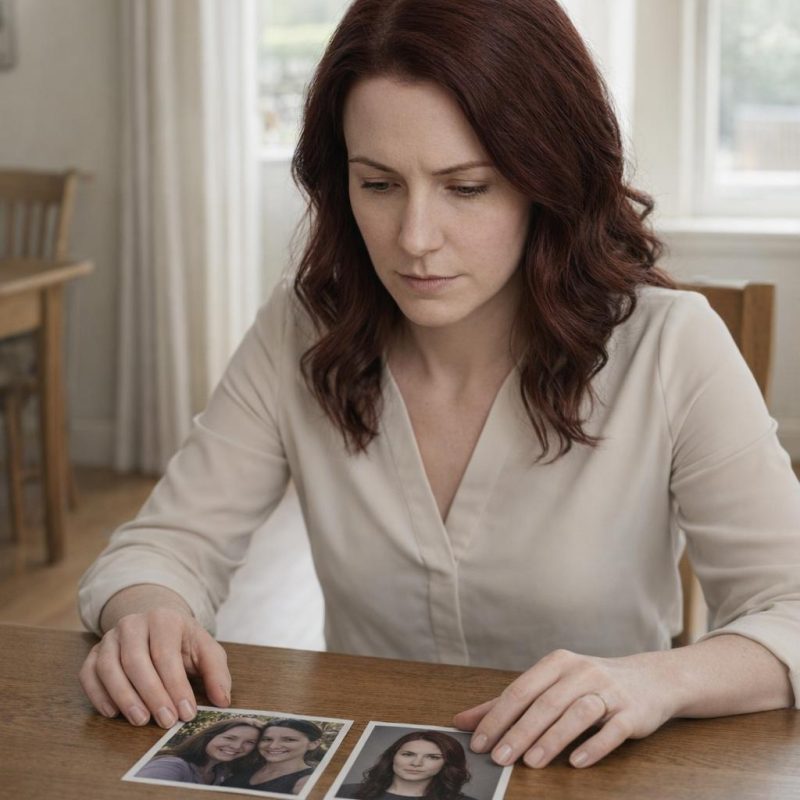 Image by RM AI
Resemblance
I took my phone into the bathroom and stood in front of the mirror. I'd been staring at those photos for an hour and I needed to see it differently — needed to hold the images up next to something real. I pulled up the most recent photo of Sarah on my screen and held it beside my reflection. The first thing I noticed was the nose. Hers had always been a little wider at the bridge than mine, a little softer at the tip. Now it wasn't. The second thing was the cheekbones — the way the light caught them at almost the same angle it caught mine. I tilted my head. She tilted hers in the photo, or seemed to. I remembered people saying we looked alike when we were kids, the way people always said that about sisters, and I'd never thought much of it. We were sisters. Of course there was some resemblance. But this felt different from that. I kept moving the phone, comparing, and the more I looked the less I could dismiss it. The face in the photo and the face in the mirror had grown closer together than I ever remembered them being.
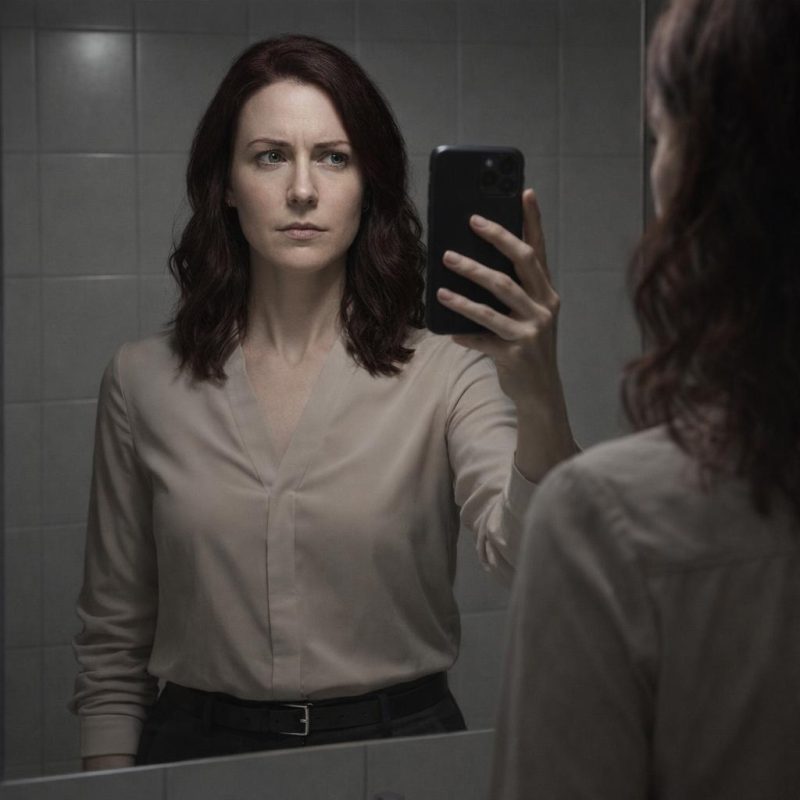 Image by RM AI
Procedures
I sat at the kitchen table with my laptop and started searching. Rhinoplasty. Facial contouring. Buccal fat removal. I wasn't sure what I was looking for exactly — I just needed to understand what was possible, what could explain what I'd seen in those photos. The before-and-after galleries were unsettling in a specific way: subtle changes, not dramatic ones, that somehow added up to a different person. I read about procedures that could narrow a bridge, lift a tip, define a cheekbone. I read that recovery from multiple procedures could take anywhere from six weeks to several months, depending on what was done and in what combination. One article talked about how patients sometimes brought in reference photos — photos of a family member, a celebrity, someone whose features they wanted to approximate. I stopped on that paragraph and read it twice. I thought about the photos I'd been comparing all afternoon. I thought about the timeline — when Sarah's face had started to look different, when I'd first noticed something I couldn't name. I closed the laptop slowly. I didn't have proof of anything. But the possibility had settled somewhere in my chest, cold and quiet, and I couldn't make it move.
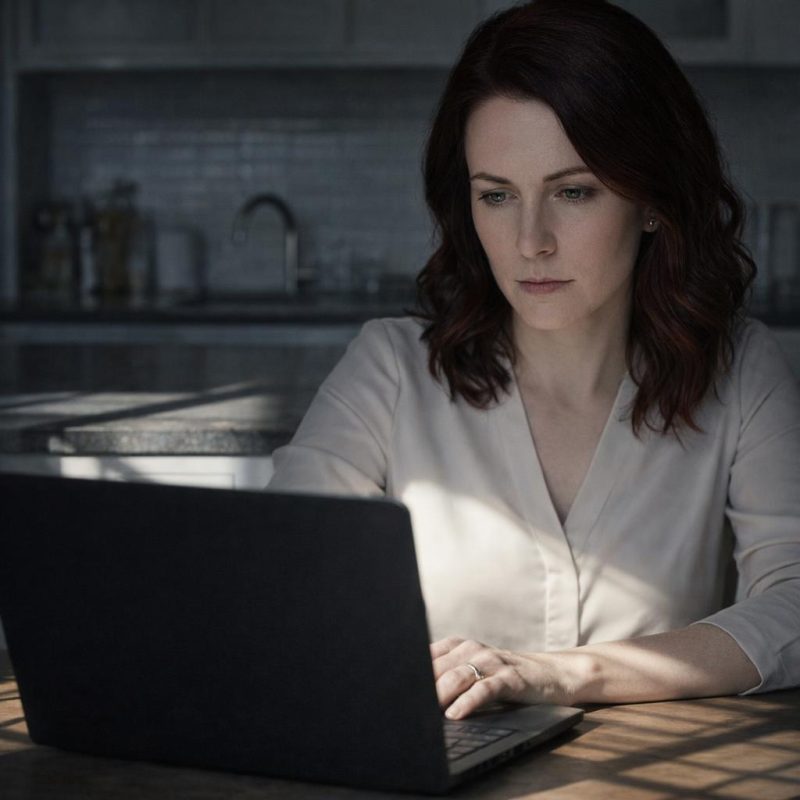 Image by RM AI
Access Plan
I told Mark that night. I laid it out as plainly as I could — the photos, the research, the feeling I couldn't shake. He listened without interrupting, which was how he always listened when something worried him. When I finished, he was quiet for a moment. Then he said he understood why I was concerned, but that searching her apartment was a different thing entirely. He said the word 'legal' twice. I told him I knew that. I told him I wasn't planning to take anything or damage anything — I just needed to see what was there. He said that wasn't really the point. I said I knew that too. We went back and forth for a while, neither of us raising our voices, both of us knowing I'd already made up my mind. The thing was, I didn't have enough to go to Nicole with yet. I didn't have enough to confront Sarah with. I had photos and a bad feeling and a browser history full of cosmetic surgery articles. That wasn't evidence. I needed something concrete. I remembered that my mother kept a spare key to Sarah's apartment on her keyring — she'd mentioned it once, years ago, after Sarah locked herself out. I picked up my phone and texted my mother asking if she still had it.
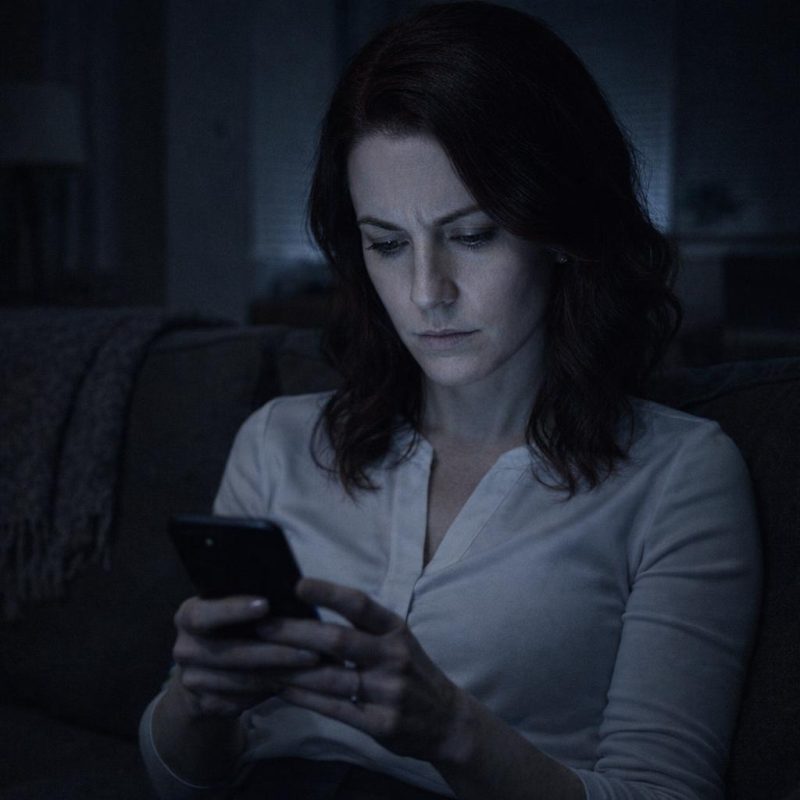 Image by RM AI
The Key
We met for coffee two days later, my mother and I, at the café near her house that she'd always preferred. She looked tired. She mentioned that Sarah had seemed stressed lately — distracted, she said, not herself — and I nodded and said I'd noticed too, which wasn't entirely a lie. I told her Sarah had mentioned a work trip coming up and had asked me to check on her plants while she was gone. My mother accepted this without hesitation. She unclipped the spare key from her keyring right there at the table and slid it across to me. I watched her do it and felt something drop in my stomach. She trusted me completely. She trusted both of us, in the uncomplicated way she always had, and I was sitting across from her using that trust to get something I had no right to ask for. I said thank you. I said I'd make sure the plants were fine. She patted my hand and changed the subject to something about a neighbor, and I sat there half-listening, turning the key over in my fingers under the table. It was small and ordinary-looking. A standard apartment key, brass, slightly worn at the teeth. I closed my hand around it, and it sat cold and heavy in my palm.
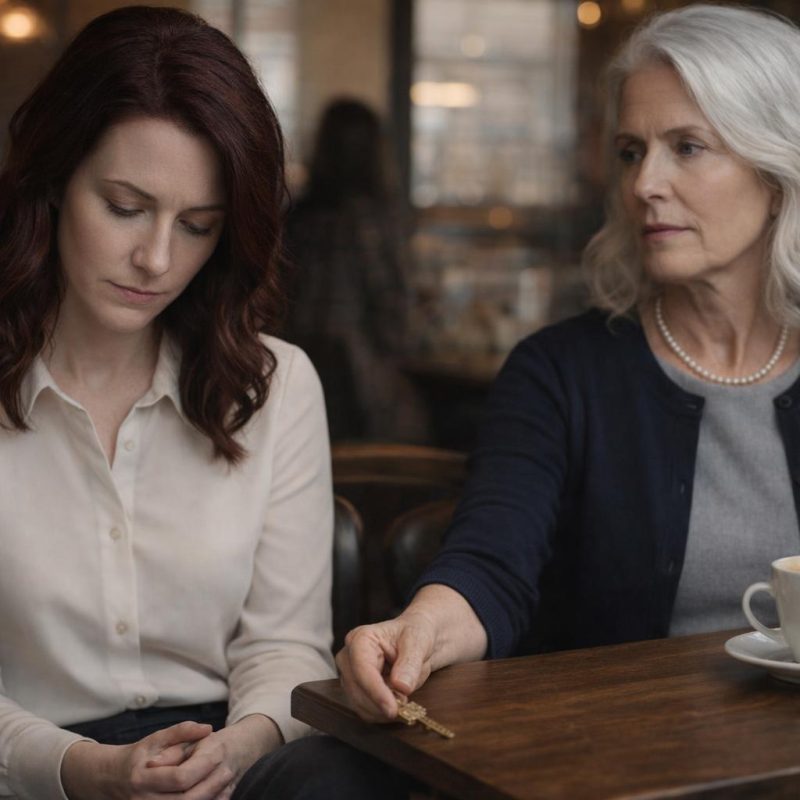 Image by RM AI
Threshold
I drove to Sarah's building on a Thursday morning, when I knew she'd be at work. I parked down the block, not in front of the building, which felt both sensible and ridiculous at the same time — like I was in a movie I hadn't agreed to be in. I sat in the car for a few minutes. I thought about turning around. I thought about calling Rachel, or Nicole, or Mark, and telling one of them what I was about to do. I didn't call anyone. I got out of the car, walked to the entrance, and took the elevator to the fourth floor. The hallway was quiet. I stood outside her door for longer than I needed to, key in hand, listening for any sound from inside. Nothing. I told myself I was doing this because I had to, because the alternative was waiting for something else to happen to me, and I was done waiting. I put the key in the lock. It turned on the first try. Then I pushed the door open and pulled it shut behind me, and I was standing in the silence of her apartment.
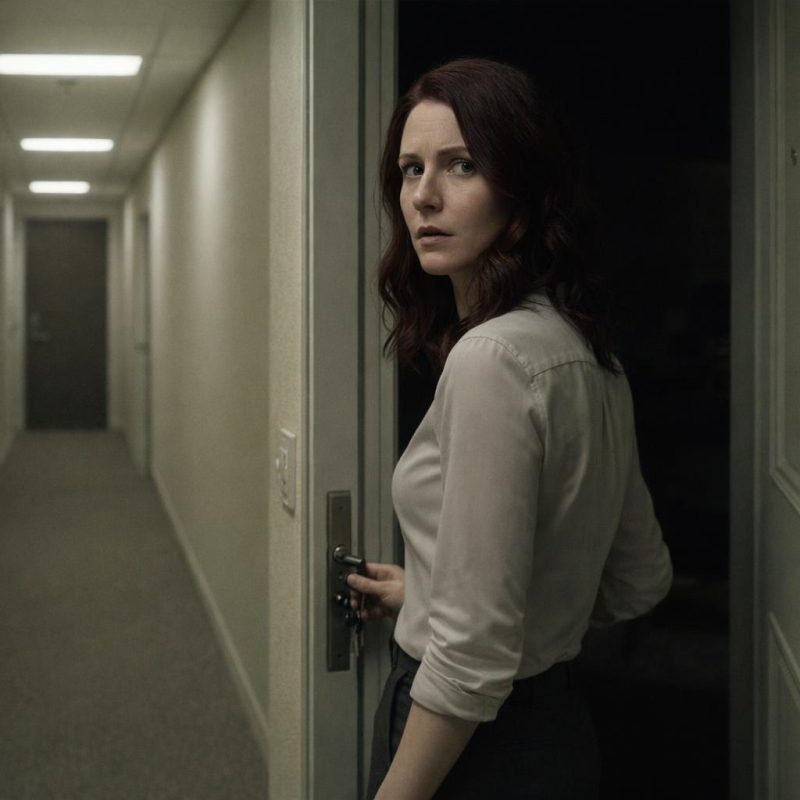 Image by RM AI
Makeup
I started in the bathroom because it felt like the least invasive place to begin, which I understood even then was not a rational thought. I opened the cabinet under the sink first — cleaning supplies, spare toiletries, nothing unusual. Then the drawer beside the mirror. Makeup, brushes, a few prescription bottles I didn't look at closely. In the second drawer I found a notebook, spiral-bound, the kind you'd buy at a drugstore. I almost put it back. I opened it instead. The first few pages were what they looked like — makeup tutorials, product names, application steps written out in Sarah's handwriting. Then I turned a few more pages and the notes changed. They got more specific. There were diagrams — actual sketched diagrams — with annotations. One page had a heading that read 'eye shape — M' with arrows pointing to a drawing of an eye and notes about liner placement and shadow depth. Another page said 'cheekbone structure — M' and described a contouring technique in careful detail. M. I stood there holding the notebook, turning pages slowly. There were at least a dozen entries like that, each one precise, each one referencing the same initial. I set the notebook back in the drawer exactly as I'd found it and stood very still, my hands at my sides, with the weight of what I'd just read sitting on me like something physical.
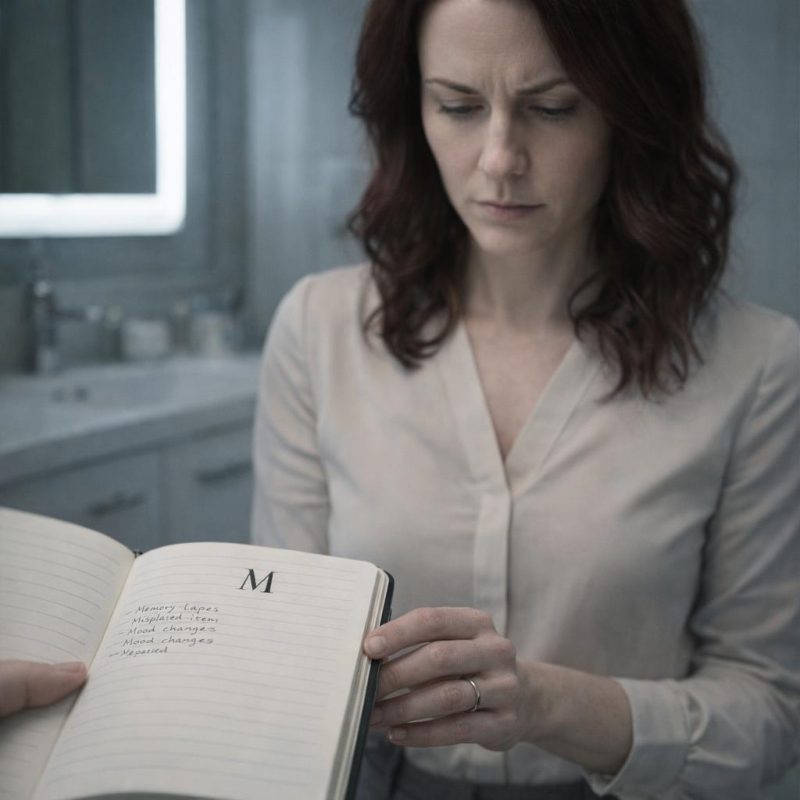 Image by RM AI
Receipts
I moved to the bedroom and sat down at the small desk in the corner. I opened the top drawer first — pens, a phone charger, a few loose receipts from grocery stores. The second drawer had folders in it, the kind with the colored tabs, organized in a way that surprised me a little. Sarah had always seemed scattered to me, but this was methodical. I pulled the folders out one by one. The third one I opened had medical paperwork in it. Not insurance forms — receipts. Payment confirmations, each one printed on the letterhead of a cosmetic surgery practice I didn't recognize, with an address in a part of the city I didn't associate with Sarah. I spread them out on the desk surface and looked at the dates. The earliest one was eighteen months ago. The most recent was six months ago. There were seven receipts in total, each one for a different procedure or follow-up, each one showing a balance paid in full. I didn't know enough about the specific procedures listed to understand exactly what had been done. But the dates were there, and the amounts were there, and the number of visits was there, and I sat with all of it spread out in front of me, unable to look away from what the pages added up to.
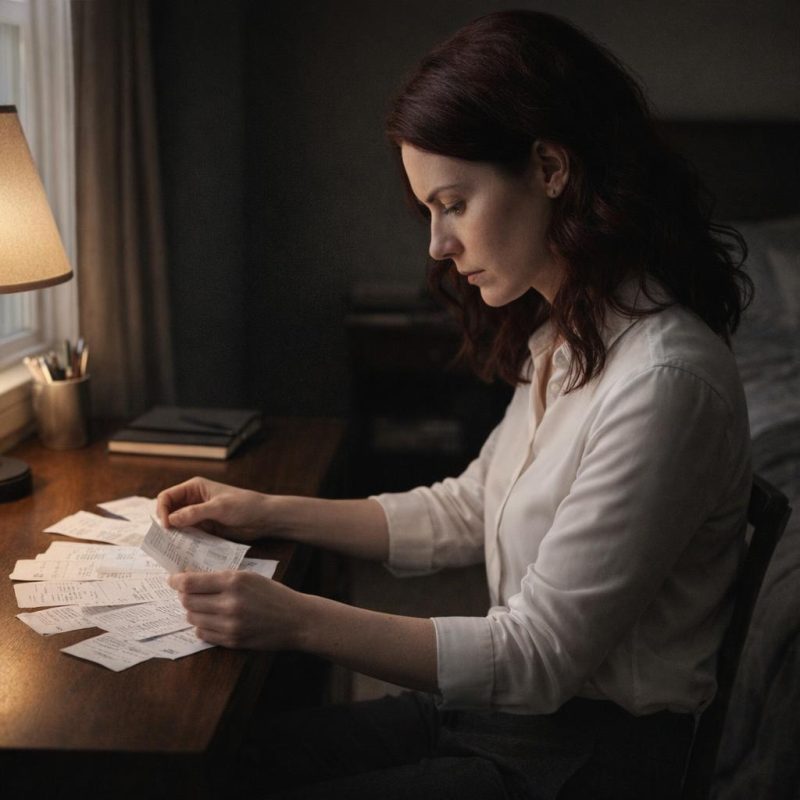 Image by RM AI
Locked Drawer
I was putting the folder back when I noticed the bottom drawer. I'd assumed it was the same as the others, but when I pulled the handle it didn't move. I tried again. Locked. There was a small keyhole, the kind that came standard on cheap office desks, and I looked around the desktop and the other drawers for a key but didn't find one. I stood there for a moment, thinking about what I'd already found, thinking about the notebook in the bathroom and the receipts on the desk. Whatever was in this drawer, Sarah had locked it. That meant something. I knew I should leave. I'd already crossed more lines than I'd planned to. But I also knew I wasn't going to walk out of the apartment without seeing what was inside. I found a paperclip in the top drawer, straightened it out, and bent one end into a small hook the way I'd once seen done in a video I'd never thought I'd have a reason to remember. I crouched in front of the drawer and worked the end of the clip into the keyhole. My hands were trembling. I adjusted the angle, applied a little pressure, adjusted again. Then I heard the lock click open.
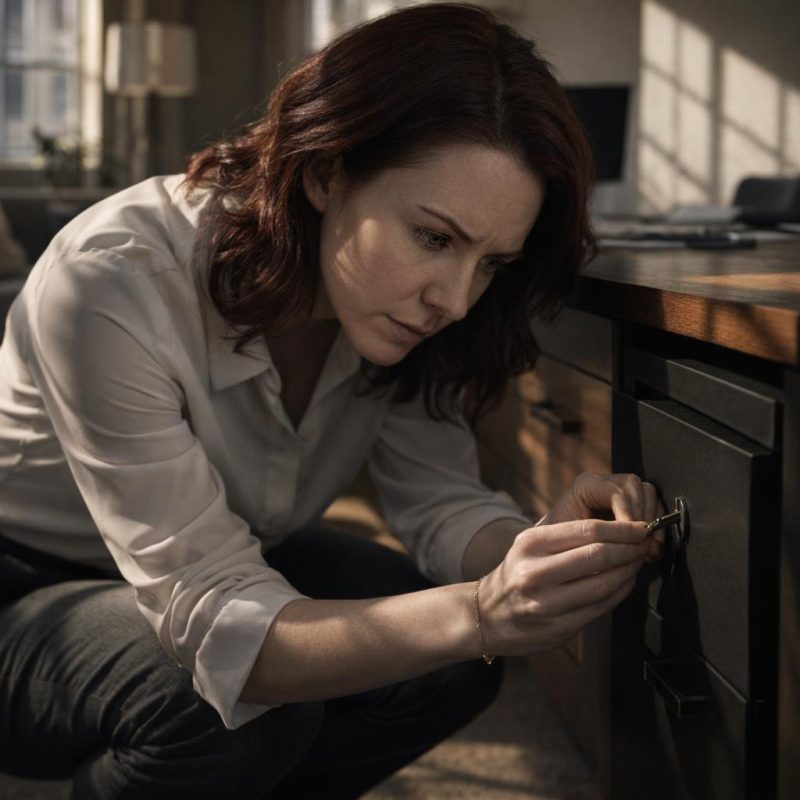 Image by RM AI
The Drawer Opens
The lock gave with a soft click, and I pulled the drawer open slowly, like I was afraid of what the air inside might carry. It wasn't deep — maybe four inches — but it was organized in a way that felt deliberate, careful. File folders lined the back, their tabs facing up, labeled in Sarah's small, precise handwriting. But it was what sat on top of them that stopped me. A journal. Leather-bound, dark brown, the kind you'd find at a boutique stationery shop. The cover was worn at the corners, the spine creased from repeated opening, the leather soft and darkened where hands had held it again and again. Sarah's name was embossed near the bottom right corner in gold lettering that had mostly faded. I stared at it for a long moment before I reached in. When I lifted it out, it was heavier than I expected — not physically, maybe, but in some other way I couldn't name yet. I stood there in the middle of my younger sister's bedroom, holding something I hadn't been invited to hold, and the weight of it settled into my palms like a question I wasn't sure I wanted answered.
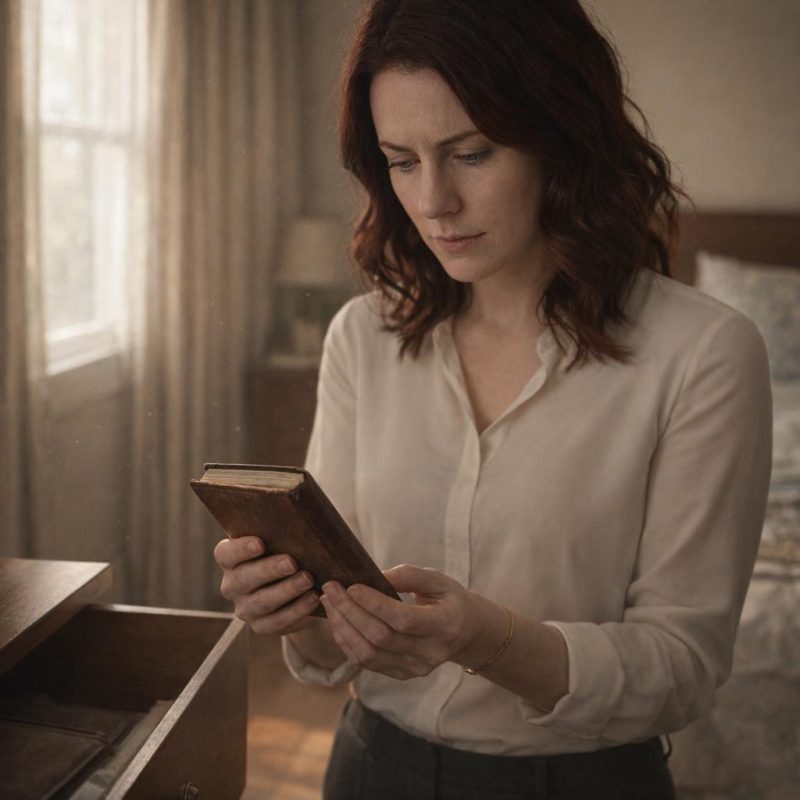 Image by RM AI
First Pages
I sat down on the edge of Sarah's bed and opened the journal. The first entry was dated almost two years ago, written in the careful, looping script Sarah had always used when she was trying to be precise. She wrote about a family dinner — one I remembered, actually, a birthday gathering at my mother's house. But the way she described it was nothing like how I'd experienced it. She wrote about watching me across the table. The way I laughed. The way Mark leaned toward me when I spoke. She'd noted what I was wearing, down to the earrings. I turned the page. The next entry was similar. Another gathering, another careful inventory. My haircut. The way I held my wine glass. A phrase I'd used that she'd written down in quotation marks and underlined. I kept reading, and the entries kept coming — not every day, but regular enough, consistent enough, each one a little more focused than the last. She'd been paying attention to me in a way I hadn't noticed, in a way that felt nothing like admiration and nothing like sisterly affection. The pages felt cold under my fingers, and I sat very still with the careful documentation of my daily routines pressed open in my lap.
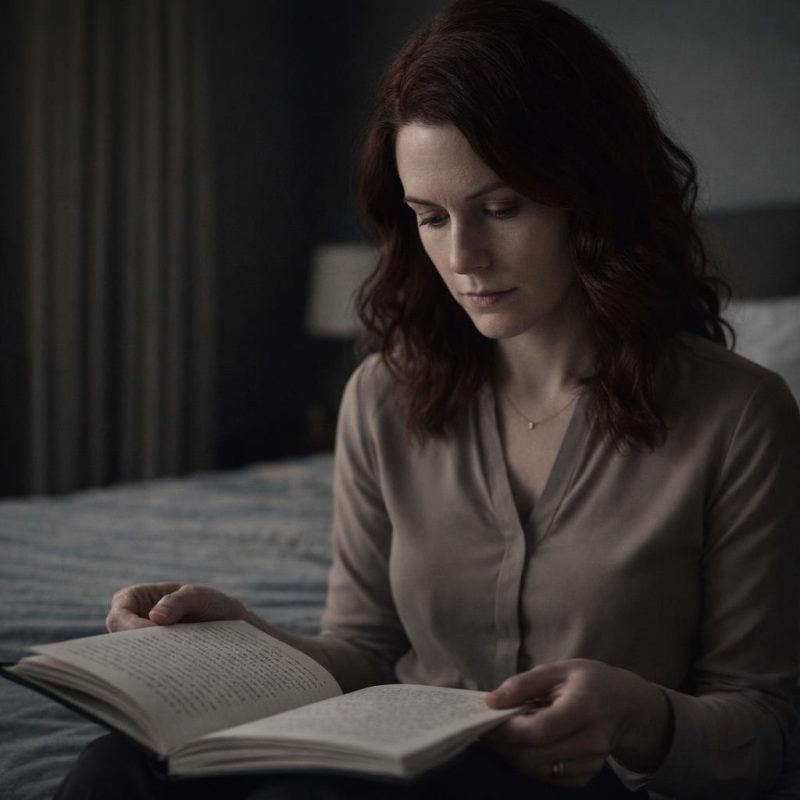 Image by RM AI
Surgical Consultations
A few dozen pages in, the tone of the journal shifted. The entries stopped being observations and started reading like research notes. Sarah had visited a cosmetic surgeon — she named the clinic, noted the date, recorded the consultation fee. She listed procedures with the kind of specificity that made my stomach turn: rhinoplasty, cheek augmentation, blepharoplasty. Each one had a cost estimate beside it, a projected recovery window, a note about what result she was expecting. She wrote about bringing photos to the consultations. Photos of me. She described showing them to the surgeon and asking how close they could get. I read that sentence twice. Then a third time. I turned the page and a small stack of printed photographs slipped out from between the pages, paper-clipped together. They were photos of me — candid shots from family events, a few that looked like they'd been cropped from group pictures, one that I was almost certain had been taken without my knowledge at a restaurant. My face, printed out and carried into a surgeon's office as a reference image. I set them down on the bed beside me, and for a moment I couldn't move.
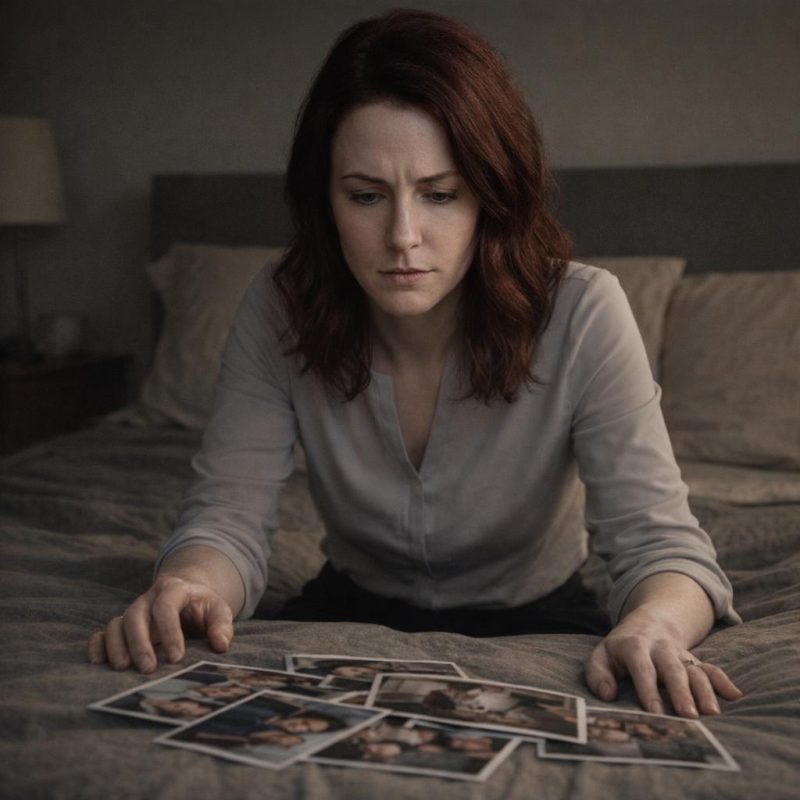 Image by RM AI
Timeline of Transformation
The entries that followed tracked time in a way that made my chest feel hollow. Sarah documented her recovery from the first surgery in careful, almost clinical detail — the swelling, the bruising, the weeks of keeping her face out of photographs. She wrote about the discomfort with a kind of patience that unsettled me, like she'd accepted it as a necessary cost. Then the tone shifted again. Later entries were lighter, almost excited. She wrote about seeing the results emerge as the healing progressed. She wrote about practicing expressions in the mirror — my expressions, the ones she'd catalogued in those early pages. She described getting my haircut, buying clothes in colors she'd noted I favored. Each entry moved a little closer to something I couldn't fully name yet, something that sat at the edge of my understanding and made my hands go cold. And then I reached the entry dated about eight months ago. The handwriting was steadier than it had been in earlier pages, almost calm. She wrote about standing in front of her bathroom mirror that morning and, for the first time, not seeing herself looking back.
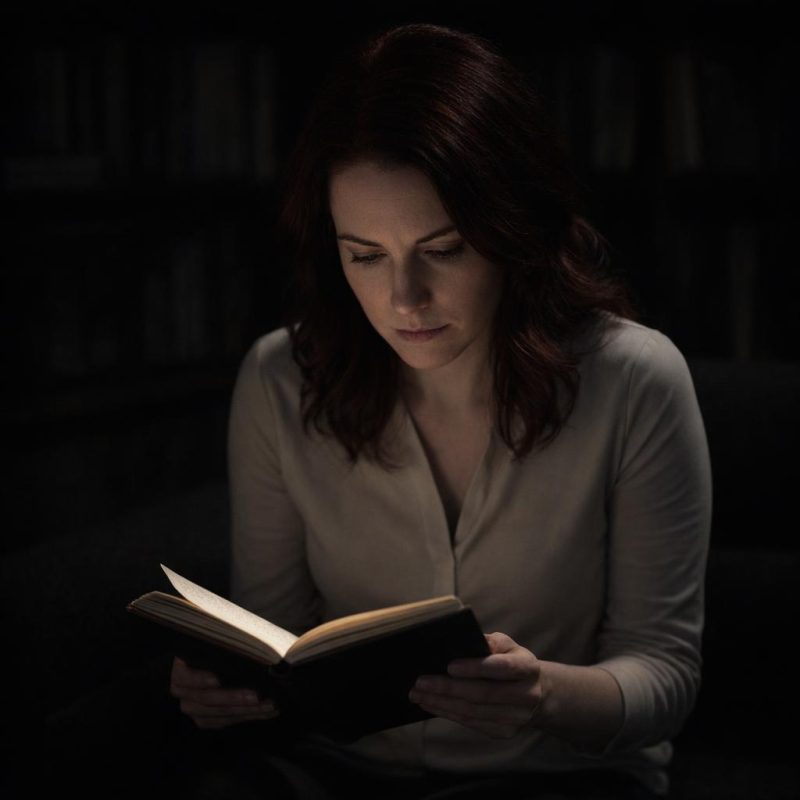 Image by RM AI
The Blueprint
The final section of the journal was different from everything before it. The entries were shorter, more direct, written like a checklist being worked through. Sarah had accessed our shared family doctor's records — she wrote about it plainly, explained how she'd done it, noted the date she'd obtained my old sonogram images. She described learning photo editing software over several months, practicing on test images before she felt confident enough to work with the real ones. She wrote about building composite images using photos of Mark she'd collected from my social media and her own phone. She explained why she'd chosen our anniversary — not just for the symbolism, but because she'd written that the grief around our brother's death anniversary would leave me less steady, less able to think clearly. The journal entries laid out the confrontation scene in detail: my likely responses listed in one column, her planned replies in another. The pages that followed mapped out what came after — the separation, the divorce proceedings, the slow process of stepping into the space I'd leave behind — written in her hand, in her words, on the page in front of me. Every phase had a timeline. Every contingency had a note. I sat on the edge of her bed with the journal open across my knees, staring at the detailed timeline for executing each phase of the plan.
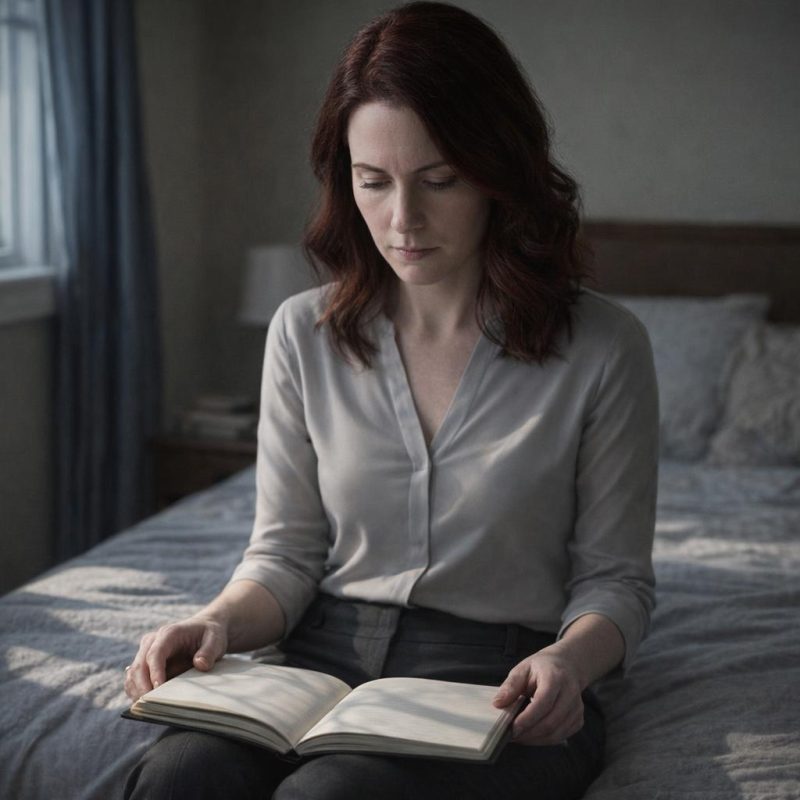 Image by RM AI
Evidence Captured
I don't know how long I sat there before something in me shifted from stunned to moving. I pulled out my phone. My hands were shaking badly enough that I had to take the first few photos twice, checking the screen to make sure the text was legible before turning the page. I worked through the journal from the beginning — every entry, every page, front and back. When I reached the surgical receipts tucked into the inside cover pocket, I photographed those too. The printed photos of me, the ones she'd paper-clipped between the pages, I photographed each one individually. I backed everything up to cloud storage before I'd even finished, watching the upload bar move across the screen with a focus that felt almost mechanical, like my brain had decided that functioning was the only option available right now. When I had everything, I went back through my camera roll and checked each image against the page it came from. Then I closed the journal, replaced the photos and receipts exactly as I'd found them, set it back on top of the file folders, and eased the drawer shut until I heard the lock catch.
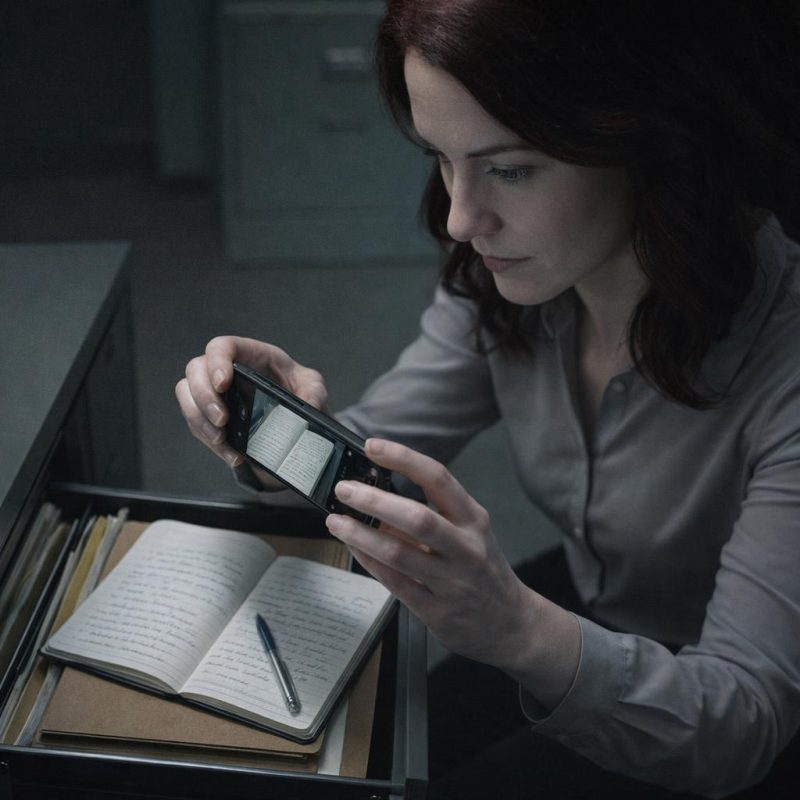 Image by RM AI
Driving Home
I sat in my car outside Sarah's building for a while before I could make myself start the engine. The street was quiet. A few lights on in the windows above me, ordinary lives going on behind ordinary glass. I gripped the steering wheel with both hands and breathed until my vision steadied. Then I drove. I don't remember much of the route home. My hands knew the turns. At some point I thought about Sarah at seven years old, the way she used to follow me around the house, asking to borrow my things, wanting to know what I was reading, what music I liked. I thought about our brother, and the way his absence had hollowed something out in all of us, and how grief does different things to different people, and how I hadn't understood until tonight what it had done to her. I wasn't angry yet. I think I was too far past anger for it to reach me. What I felt was closer to mourning — for the sister I'd thought I had, for the version of her that existed before whatever this was had taken root. By the time I pulled into my driveway, the tears had dried on my face without my noticing them fall. The engine ticked as it cooled, and the silence of the car settled around me.
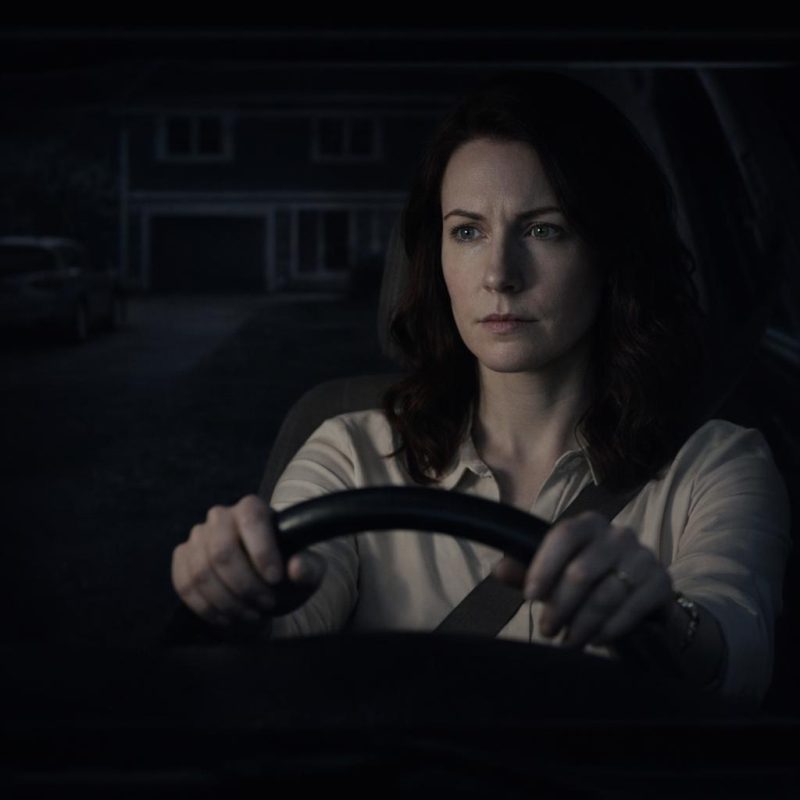 Image by RM AI
Showing Mark
Mark was in the living room when I came in, sitting on the couch with his laptop open, and he looked up the moment he saw my face. He closed the laptop without a word. I sat down beside him and didn't say anything for a moment. Then I unlocked my phone and opened the camera roll and handed it to him. He looked at the first image, then the second, and I watched his expression change in a way I'd never seen before — a slow, careful going-still, like something inside him was bracing. He scrolled without speaking. I watched him read the entries about the surgeries, about the photos she'd brought to the consultations. I watched him reach the pages about the fabricated images, about the anniversary timing, about the plan she'd mapped out in that careful, patient handwriting. At some point he set the phone down on the cushion between us and put his face in his hands. I leaned into him and he put his arm around me and we stayed like that for a long time, not talking, the full weight of what Sarah had built and what we now knew pressing down on both of us in the quiet of our living room.
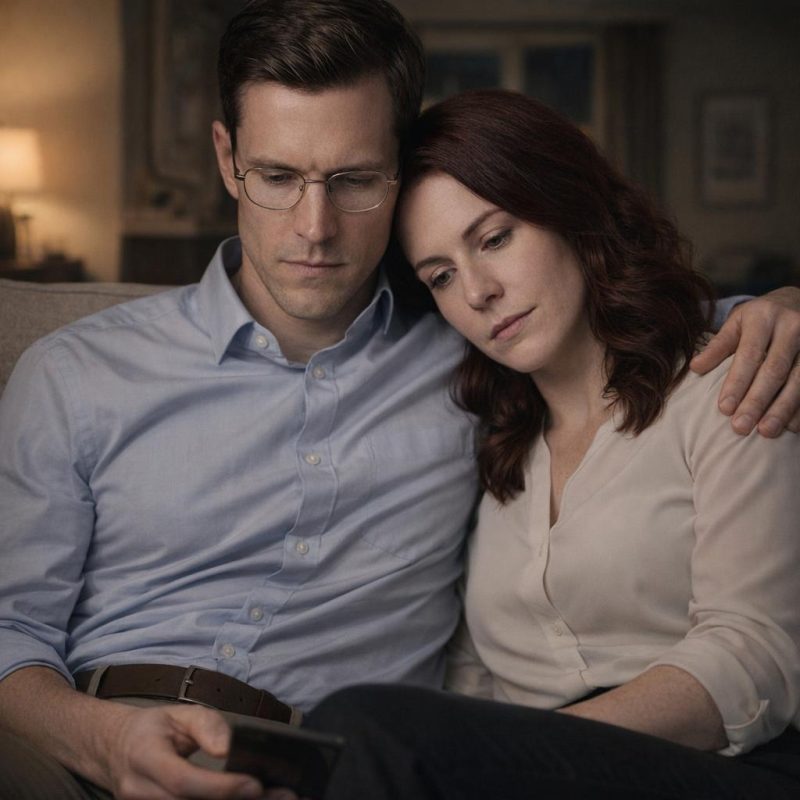 Image by RM AI
Calling Nicole
We sat on the couch for another hour before I finally picked up my phone and called Nicole. I hadn't spoken to her in weeks, and her voice when she answered was brisk and professional until I said Sarah's name — then she went quiet and listened. I walked her through everything: the apartment, the journal, the surgical receipts, the photos Sarah had brought to the consultations. Mark sat beside me the whole time, his hand on my knee, steady. I told Nicole I'd photographed every page and I sent the files to her secure email while we were still on the call. I could hear her clicking through them on the other end, and the silence stretched long enough that I started to wonder if the connection had dropped. Then she came back, and her voice had changed — pulled tighter, more deliberate. She said the journal alone documented fraud, identity theft, and what she described as a pattern of stalking behavior. She said the forensic photo analysis made the fabrication case airtight. She said we had more than enough. Then she told me we needed to file a police report tonight.
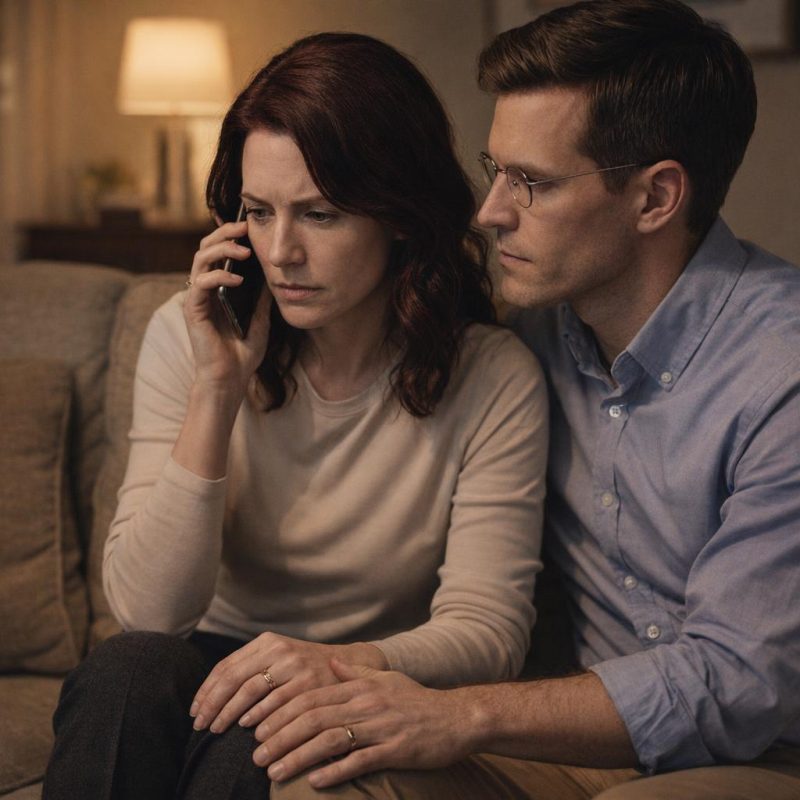 Image by RM AI
Police Report
We got to the police station just after nine. The front desk officer directed us to a small interview room with fluorescent lighting and a table that wobbled slightly when I set my folder down. Detective Morrison came in a few minutes later — salt-and-pepper hair, a weathered face, the kind of tired eyes that have seen enough to stop being surprised by most things. He introduced himself, shook both our hands, and sat down across from us with a legal pad. I started from the beginning: the anniversary dinner, Sarah's accusation, the weeks of investigation, Rachel's help with the forensic analysis, the apartment visit, the journal. I laid the printed photos on the table in the order I'd found them — journal pages, surgical receipts, the before-and-after consultation photos. Morrison didn't interrupt. He made notes in a small, even hand and asked clarifying questions only when I paused. When I slid the journal printouts across to him, he picked them up one by one and read each page carefully. His jaw tightened on the third page. He set it down, picked up the next one, and his expression shifted — not surprise exactly, but something that looked like recognition of a pattern he'd seen before, settling into something harder and more certain.
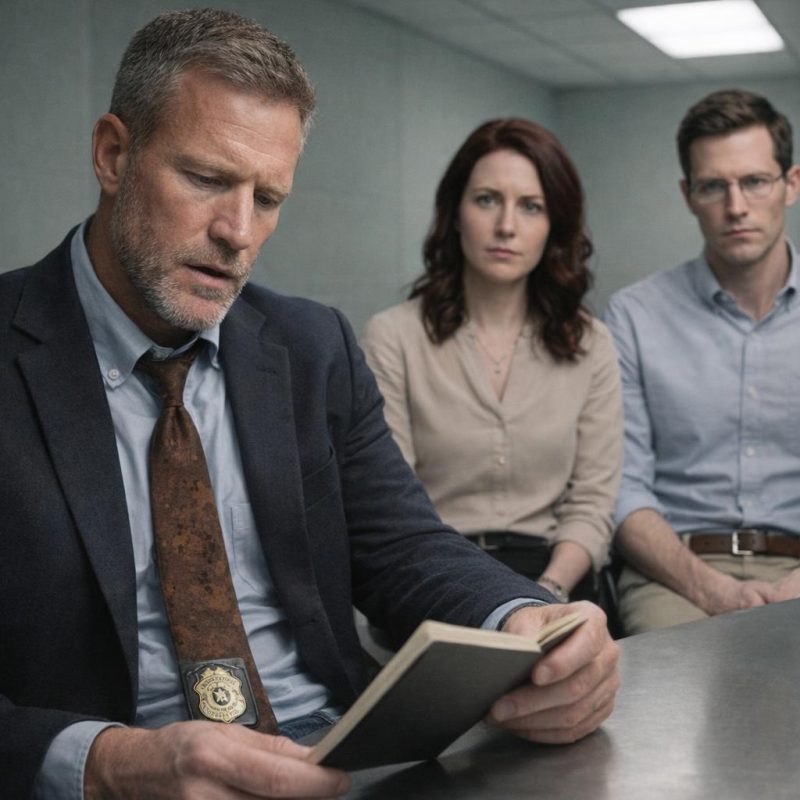 Image by RM AI
Waiting
Morrison told us he'd be in touch within twenty-four hours. We drove home in near silence, and the house felt strange when we walked back in — too quiet after everything, like the air itself hadn't caught up yet. Mark made tea neither of us really wanted and we sat at the kitchen table with our phones face-up between us. I kept glancing at mine every few minutes even though I knew Morrison had only just left the building. Mark reached over at some point and covered my hand with his, and I turned my palm up and held on. We talked a little — about what would happen when Sarah was contacted, about whether she'd deny everything, about what Nicole had said regarding the legal process. But mostly we just sat there. The investigation was out of our hands now, and after weeks of moving and digging and documenting, the stillness felt almost unbearable. At some point the kitchen light flickered once and steadied. Outside, a car passed and its headlights swept across the wall and were gone. The house settled around us in the dark, quiet and waiting.
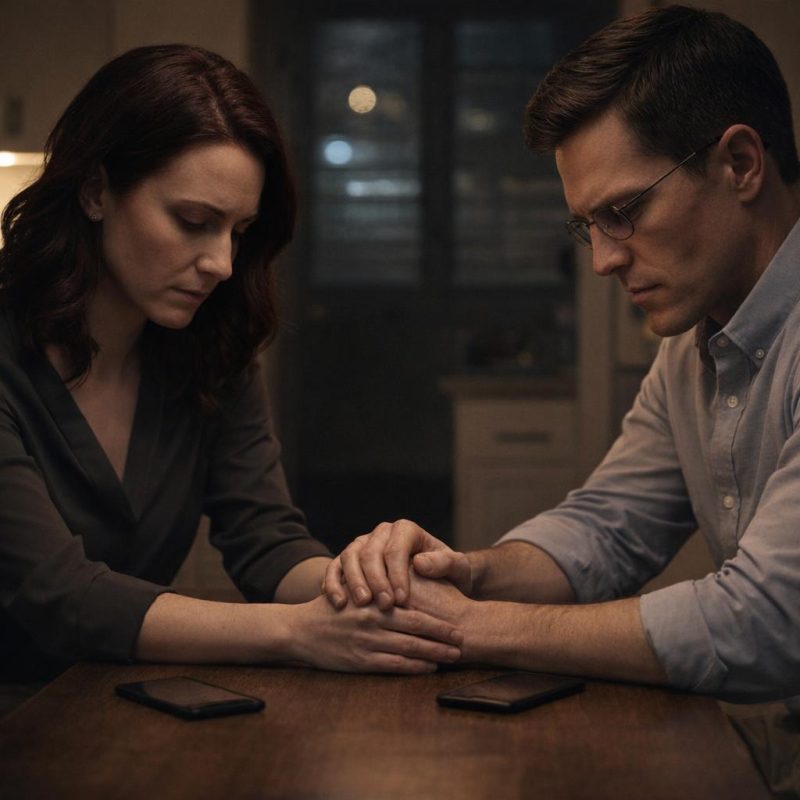 Image by RM AI
The Plan
Morrison called the next morning at ten. His voice was measured and unhurried, and he walked us through the plan methodically. He said he'd reviewed all the evidence and consulted with the district attorney's office. He wanted to bring Sarah in for an interview, but he wanted to do it in a controlled setting — the station, not her apartment, not our home. He explained that our presence would be important, that confronting Sarah with the people she'd accused would be part of the process. Nicole had already been in contact with his office, he said, and she'd confirmed she'd be there as my legal representative. He told me what to expect: Sarah would be told she was coming in to provide a follow-up statement about her original allegations. She wouldn't know we'd be there. Morrison would present the evidence in stages and give her the opportunity to respond. He said to let him lead. He said to stay calm no matter what she said. I wrote everything down on the notepad I'd been keeping since the beginning of all this. When I hung up, I looked at the page — the time, the address, the sequence of events. The meeting was scheduled for the following afternoon at two o'clock.
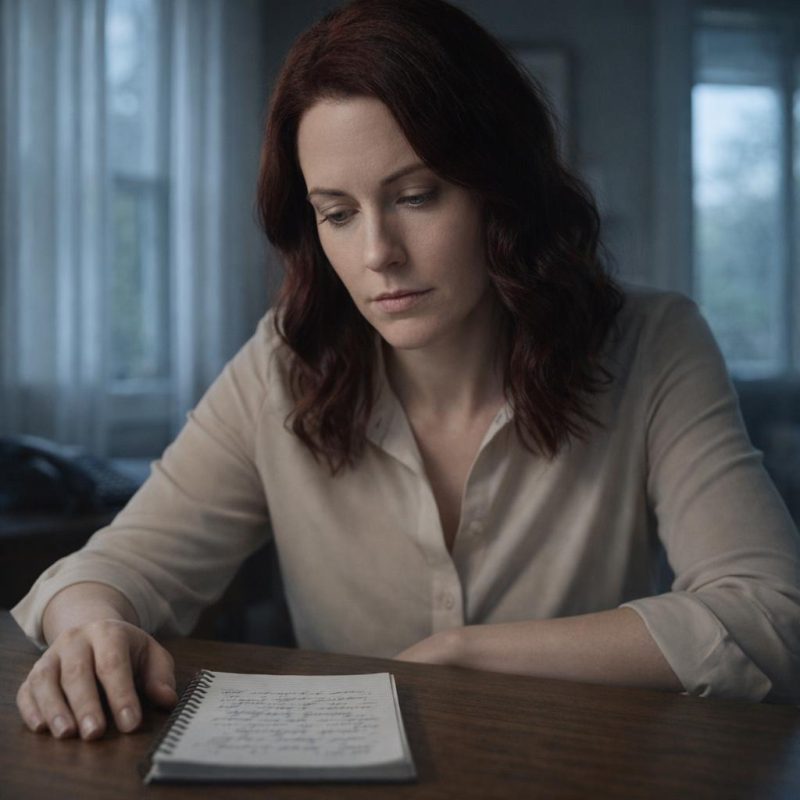 Image by RM AI
Arrival
We arrived forty minutes early. Nicole was already there, standing in the corridor outside the interview suite in a charcoal blazer, her auburn hair pulled back, a leather portfolio under her arm. She squeezed my hand when she saw me and didn't say anything unnecessary. Morrison met us in the hallway and walked us through the room layout — where we'd sit, where Sarah would be placed, how he'd open the interview. He told us again to let him lead. Mark stood close beside me the whole time, his shoulder against mine. At one fifty-eight, I heard the front desk officer's voice down the corridor, and then I heard Sarah's — bright and cooperative, the tone she used when she wanted to seem helpful. She came around the corner in a cream-colored blouse, her hair styled, her posture easy and confident. She was already talking to the officer beside her when she stepped through the doorway and saw us. The words stopped. Her eyes moved from Morrison to Nicole to Mark to me, and she went very still. I watched her face in that moment — the practiced composure holding for just a second before something underneath it shifted, and the room felt different with all of us in it together.
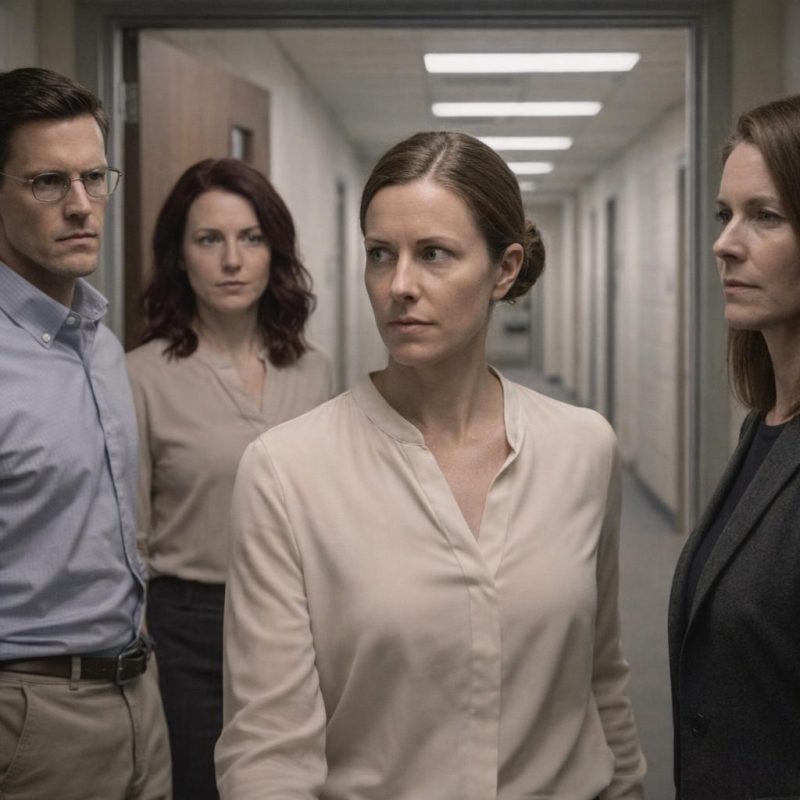 Image by RM AI
Confrontation
Morrison asked Sarah to take a seat and she did, smoothing her blouse as she sat down, her hands folding on the table in front of her. He thanked her for coming in and asked her to walk him through her original allegations one more time. She did it without hesitating — the affair, the pregnancy, the dates, the details she'd rehearsed so many times they came out clean and even. I sat across from her and kept my hands flat on my thighs and said nothing. Then Morrison opened the folder. He placed the forensic analysis on the table first — the side-by-side comparison of the original photos and the manipulated versions, the metadata breakdown, the expert notation. He explained each element in plain language. Sarah's eyes moved over the pages and she said the analysis was wrong, that the photos were real, that someone must have tampered with the report. Morrison nodded and placed the next item down: a printout of the first journal page, her handwriting filling the lines. Sarah looked at it for a long moment. She said it wasn't hers. She said someone must have fabricated it. Morrison placed the second page beside the first, then the third. I watched her open her mouth, and then close it, and then open it again — reaching for something that wasn't there.
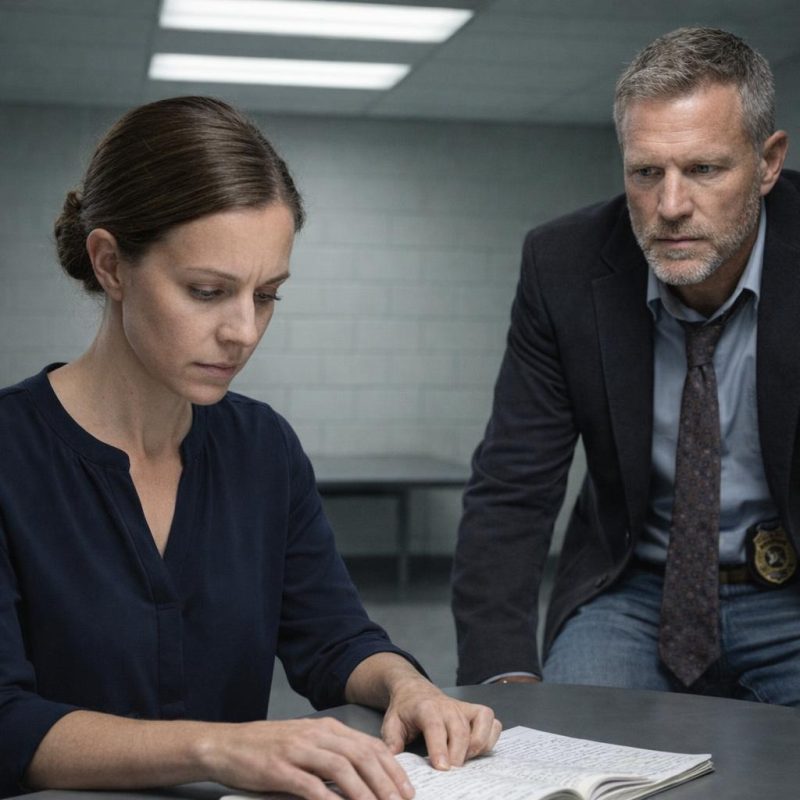 Image by RM AI
Breaking
Morrison set the surgical receipts on the table one at a time. Each one had Sarah's signature at the bottom — the same looping S, the same careful last name. He placed the hospital procedure records beside them, then the consultation photos from the journal: the printed images of my face she'd brought to the appointments, the annotated notes in her own hand. Sarah said the signatures were forged. She said the photos could have come from anywhere. Her voice had climbed higher and her hands had come unfolded on the table, fingers pressing flat against the surface. Morrison didn't raise his voice. He just kept placing items down, methodical and unhurried, and each one landed in the silence like something final. I felt Mark shift beside me. I felt Nicole go still on my other side. Sarah's denials started coming faster and less coherent — the records were wrong, the clinic had made errors, someone had set her up. Then Morrison placed the last item: the before-and-after photo she'd kept in the journal, the one where my face and hers were printed side by side with measurements marked between them. Sarah stared at it. The words stopped coming. She sat with her hands pressed to the table and her eyes fixed on that photograph, and the silence that followed was absolute.
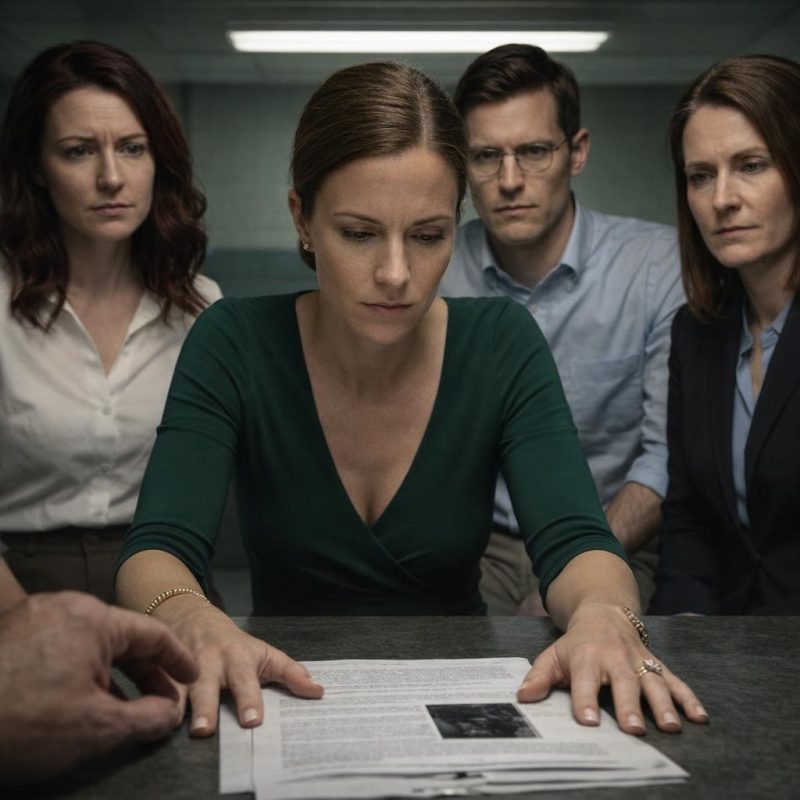 Image by RM AI
Confession
The silence held for almost a full minute. Then Sarah started talking. Her voice came out flat and exhausted, nothing like the bright cooperative tone she'd walked in with. She said after Daniel died she couldn't feel anything for a long time. She said she'd watched me from a distance — the marriage, the apartment, the life that kept moving forward — and something in her had decided that I had gotten out whole and she hadn't. She said she'd started small, just the hair, just the way she dressed, and then it hadn't been enough. She said she knew it was wrong. She said she'd told herself a hundred times to stop and she couldn't. Nicole had her pen down. Morrison was writing steadily. Mark's hand found mine under the table and I let him hold it, because I needed something solid to hold onto while I listened to my younger sister describe the years she'd spent trying to erase the distance between us by erasing me. I didn't feel vindicated. I felt something closer to grief — for Daniel, for the girl she'd been before we lost him, for whatever version of herself she'd buried under all of it. Then her voice dropped lower and she said she just wanted to become me because I was the one who survived whole.
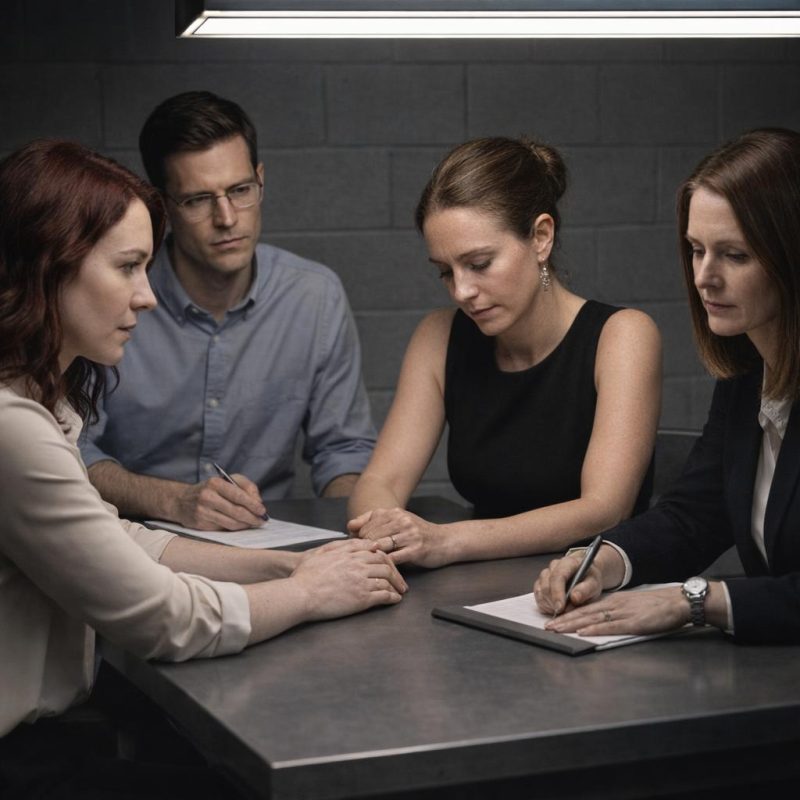 Image by RM AI
Aftermath
Morrison stood up first. He said it quietly, the way people say things they've had to say too many times — that Sarah was under arrest for fraud and identity theft, and that given everything she'd disclosed, he was arranging for a psychiatric evaluation before she was processed. Sarah didn't fight it. She sat very still while another officer came in and read her rights, and I watched her hands in her lap, small and folded, and I thought about the girl who used to follow me around our mother's kitchen asking me to teach her things. Nicole leaned close and walked me through what came next — the evaluation, the facility, the timeline for charges. I heard the words but they landed at a distance. Mark kept his hand on my back the whole time. When they walked Sarah out, she turned once at the door and looked at me, and I didn't look away. I didn't know what my face was doing. I just let her see me. The door closed behind her, and I sat there holding the full weight of what came next — for her, and for me, and for everything we'd both have to carry forward from that room.
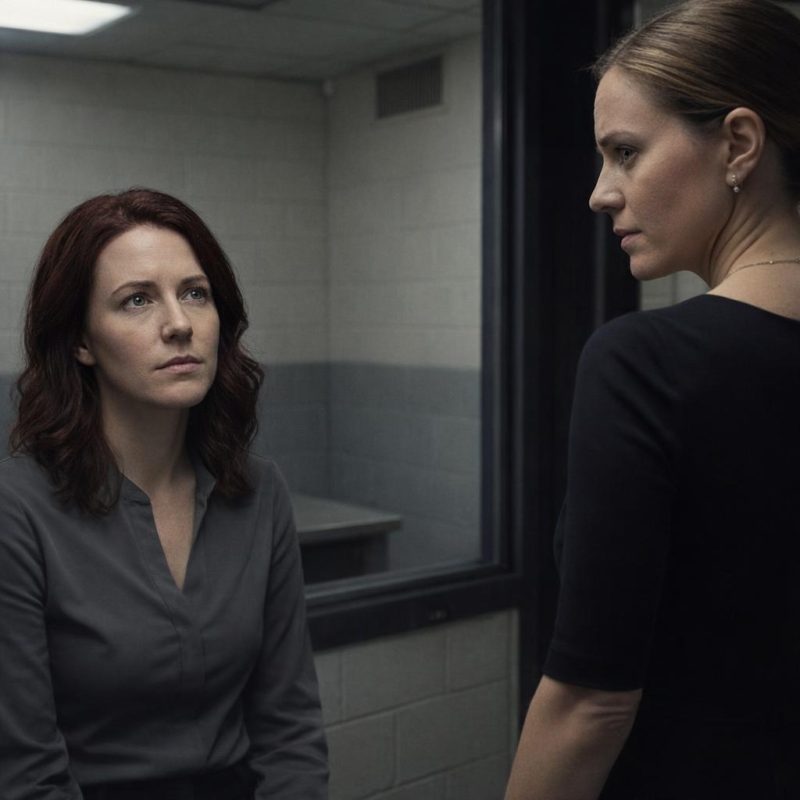 Image by RM AI
Restraining Order
Nicole filed the paperwork for the restraining order the following morning, and given the documented evidence — the fraud, the identity theft, the hospital records, all of it — the judge granted it the same day. I signed my name at the bottom of the form and felt something loosen in my chest that I hadn't realized I'd been holding tight for months. Nicole told us Sarah had been placed in a secure psychiatric facility while the legal proceedings moved forward. She said the treatment there was real, not a workaround, and I held onto that because I needed to believe it. Mark and I drove home in near silence, but it wasn't the heavy kind. It was the kind where you don't need to fill the space. That night I walked through our apartment and touched things — the kitchen counter, the back of the couch, the window latch — not looking for anything, just reminding myself that this was ours and it was safe. Mark made tea and we sat together on the couch without the television on, and the quiet that settled around us felt different from any quiet I'd known in a long time.
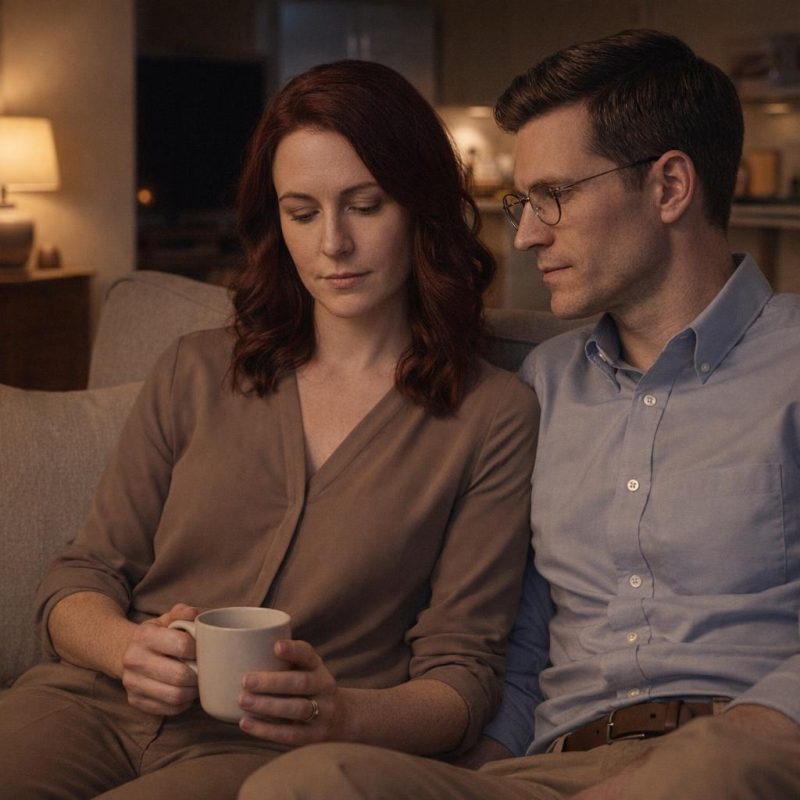 Image by RM AI
Therapy
We started therapy three weeks after the arrest. The office was on the fourth floor of a building downtown, and the therapist had a calm, unhurried way of asking questions that made it easier to answer honestly. The first session was hard. Mark talked about the night Sarah showed up at the restaurant, how he'd felt the ground shift under him and hadn't known how to reach me through the noise of it. I talked about the weeks I'd spent doubting myself, doubting him, doubting everything I thought I knew about my own life. Saying it out loud in that room, with Mark sitting close enough that our knees were almost touching, made it feel less like something that had happened to me alone. The therapist said something I kept coming back to afterward — that surviving a crisis together doesn't automatically repair the damage, but it does prove something about what you're willing to do for each other. Mark reached over and took my hand when she said it. We went back the following week, and the week after that. It wasn't fast and it wasn't easy, but there was something steady in showing up together, in doing the slow work of finding our way back to each other.
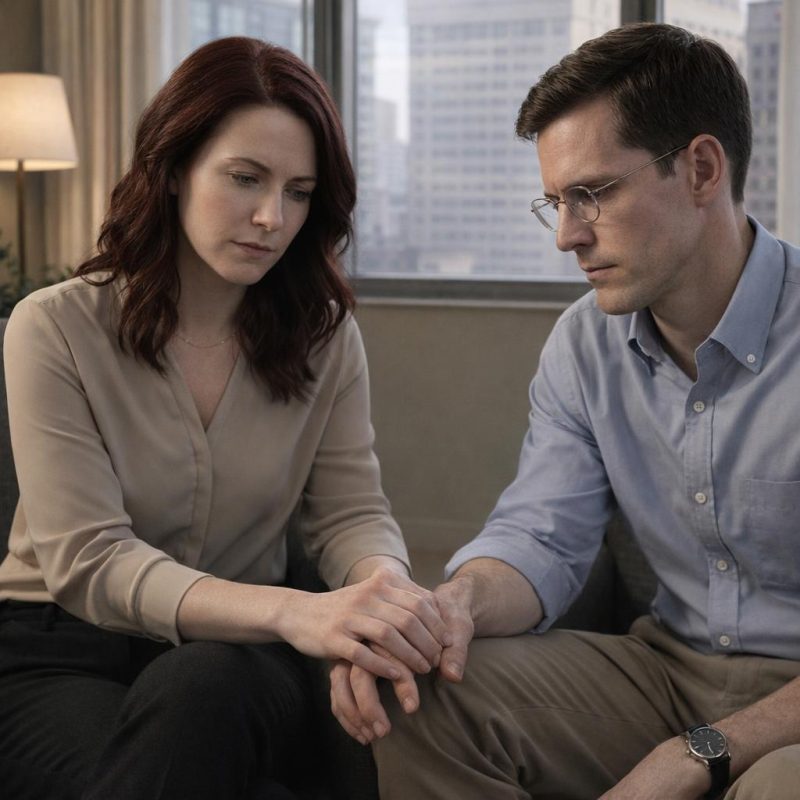 Image by RM AI
Five Years and Six Months
Six months after Sarah's arrest, Mark made dinner at home — nothing elaborate, just pasta and the good olive oil and the candles we kept forgetting to use. We'd been to two supervised family therapy sessions at the facility by then, and Sarah was making progress, or so the counselors said. I believed them, mostly. I still grieved the sister I'd grown up with, the one who existed before Daniel died and before everything calcified into something I didn't recognize. That grief didn't go away. I didn't think it was supposed to. But it had changed shape — softer at the edges, less like a wound and more like a scar. Mark poured the wine and we sat across from each other at the table we'd eaten at a thousand times, and he said, quietly, that he was glad we were still here. I told him I was too. Outside the window the city moved the way it always did, indifferent and continuous, and inside our apartment everything was still and warm and ours. I set my glass down and looked at him across the table, and what I felt wasn't happiness exactly — it was something quieter and more durable than that, the steady knowledge that we had come through it together and were still standing.
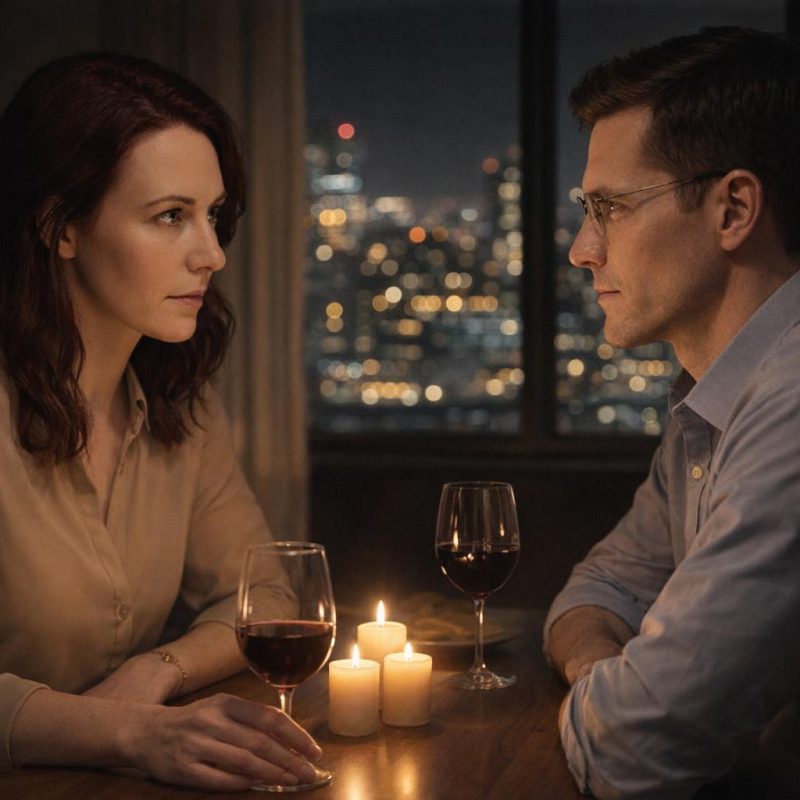 Image by RM AI